What Is a Startup Tech Stack?
A startup tech stack is the set of technologies used to design, build, deploy, and operate a product: frontend, backend, database, cloud infrastructure, and supporting tools for APIs, deployment, and monitoring.
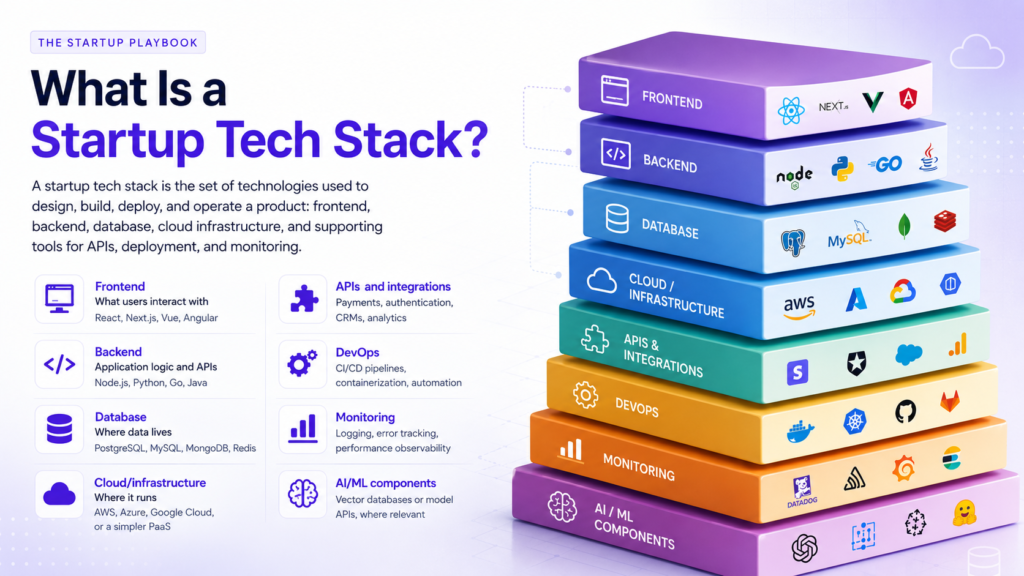
- Frontend – what users interact with (React, Next.js, Vue, Angular)
- Backend – application logic and APIs (Node.js, Python, Go, Java)
- Database – where data lives (PostgreSQL, MySQL, MongoDB, Redis)
- Cloud/infrastructure – where it runs (AWS, Azure, Google Cloud, or a simpler PaaS)
- APIs and integrations – payments, authentication, CRMs, analytics
- DevOps – CI/CD pipelines, containerization, automation
- Monitoring – logging, error tracking, performance observability
- AI/ML components – vector databases or model APIs, where relevant
These layers aren’t independent. Choosing a document database because your data feels unstructured has downstream effects on hiring and hosting costs later which is why stack selection deserves more thought than copying the last funded startup.
How Do You Choose a Tech Stack for a Startup?
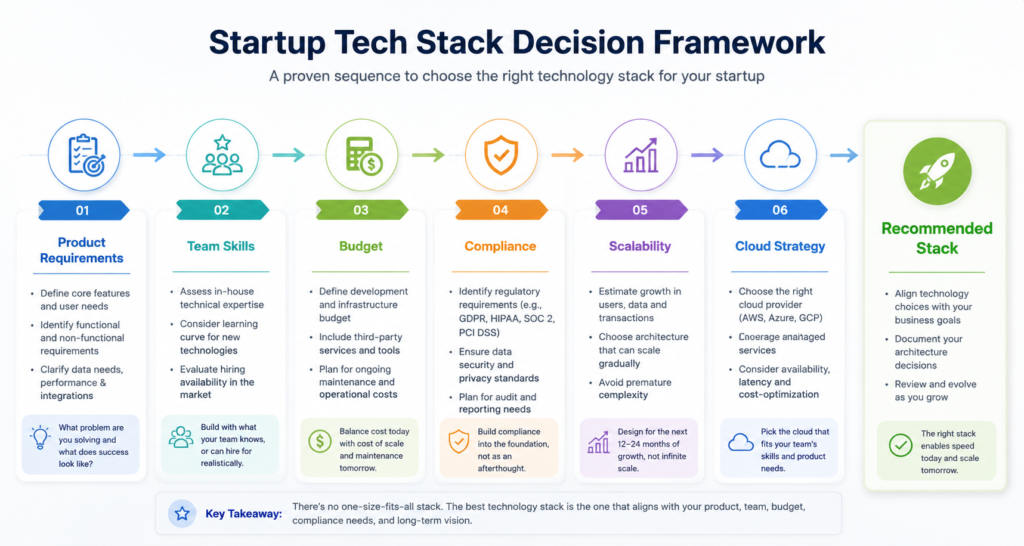
Choosing a tech stack means starting with business and product requirements, then working through team capability, budget, timeline, scalability, and compliance before selecting tools. Founders often reverse this, picking a framework a developer likes and fitting the business around it. A more reliable sequence:
- Product requirements real-time, data-heavy, and simple CRUD workflows point toward different architectures.
- MVP timeline a four-week MVP and a six-month pilot justify different bets.
- Development budget determines team size, which determines complexity you can support.
- Team expertise and hiring availability the “best” language is often the one your team knows, and niche technologies can slow hiring later.
- Scalability requirements design for growth you can forecast in 12–24 months.
- Security and compliance HIPAA, SOC 2, or PCI DSS obligations narrow options early.
- Third-party integrations and cloud strategy payment providers or CRMs sometimes dictate choices, and cloud choice affects cost and hiring.
- Long-term maintenance the team maintaining this stack in three years may not be the one that built it.
Jumping straight to “React or Vue?” without answering these first is how startups end up rebuilding a year after launch.
What Technology Stack Should a Startup Use for an MVP?
The best MVP stack lets a small team ship a working, testable product quickly without accumulating so much technical debt that iteration becomes painful favoring mature, well-documented frameworks and managed cloud services over exotic, highly distributed architectures, without ignoring future scalability entirely.
| MVP type | Example stack |
|---|---|
| SaaS product | Next.js + Node.js + PostgreSQL + AWS |
| AI-powered SaaS | Next.js + Python/FastAPI + PostgreSQL + vector database + cloud AI services |
| Mobile-first startup | React Native + Node.js or Python + PostgreSQL + AWS/Azure/GCP |
These work because each pairing uses mature, well-supported tools with a large hiring pool. A data-heavy analytics product or a regulated fintech MVP would justify a different combination match the stack to the product, not a table found online.
Frontend: Which Technology Is Best for Startups?
React remains a strong default because of its ecosystem and hiring pool, but the better question is whether you need React alone or a framework built on it, like Next.js. For most startups building a web app with SEO or performance needs, Next.js is the stronger start.
- React solid for a highly interactive app without SSR or routing needs.
- Next.js makes sense when SEO, page load performance, or a marketing site matters, which covers most consumer and SaaS startups.
- Vue reasonable when your team already knows it or the app is simple; its hiring pool is smaller than React’s.
- Angular better suited to larger, structured teams in enterprise contexts; usually more than an early-stage startup needs.
Choose Next.js for most product-focused startups. Avoid Angular for a lean MVP unless the team has deep experience with it and the product is genuinely enterprise-scale.
Backend: Node.js vs Python vs Go for Startups
Node.js, Python, and Go each fit different needs, and none is objectively “best.” Node.js suits real-time applications and JavaScript-heavy teams, Python is stronger for AI, ML, and data-heavy products, Go fits high-performance or infrastructure-focused services.
- Node.js good for SaaS APIs and real-time features (chat, notifications, dashboards), especially for teams wanting one language across the stack.
- Python the default for AI/ML products, data pipelines, and automation, thanks to FastAPI, Django, and the broader ML ecosystem.
- Go worth it for performance-sensitive services or infrastructure tooling; less common as a first backend language without prior team experience.
Avoid choosing Go for a standard CRUD-heavy MVP just because it’s fast the performance advantage rarely matters at MVP scale and usually slows early iteration.
PostgreSQL vs MongoDB: Which Database Should a Startup Choose?
PostgreSQL is generally the stronger choice for startups with structured business data and transactional requirements, while MongoDB fits products with rapidly changing or genuinely document-oriented data. Most SaaS and marketplace startups are better served by PostgreSQL by default.
Choose PostgreSQL when your data has clear relationships (users, orders, subscriptions), you need transactional integrity, or you’ll run complex reporting. Choose MongoDB when your schema changes often and doesn’t map well to tables, or you’re storing large volumes of loosely structured documents.
A common mistake: choosing MongoDB early because it feels faster, then discovering a year later the product needs relational integrity for billing and migrating under pressure. Absent a clear reason for MongoDB, PostgreSQL is the safer default.
AWS vs Azure vs Google Cloud for Startups
AWS, Azure, and Google Cloud can each support a startup well; the decision usually comes down to team familiarity and ecosystem fit. AWS offers the broadest ecosystem, Azure fits Microsoft-centric customers, and Google Cloud has particular strength in data and AI/ML tooling.
| Provider | Best fit when… |
|---|---|
| AWS | Widest range of managed services, no strong reason to prefer another provider |
| Azure | Customers or partners are already in the Microsoft ecosystem |
| Google Cloud | Product is data- or AI/ML-heavy |
Beyond the table, consider what your team knows, whether customers require a specific provider, data residency needs, and reliance on managed services versus custom infrastructure.
Should Startups Use Microservices or a Monolith?
For most early-stage startups, a modular monolith is a better starting point than microservices, unless there’s a specific reason to split services from day one. Microservices solve organizational and scaling problems most startups don’t have yet, and add overhead early teams rarely afford.
Monolith advantages: faster development, lower operational complexity, easier debugging, lower overhead.
Microservices advantages: independent scaling, team autonomy, service isolation, and a better fit once an organization outgrows a single team owning the codebase.
A modular monolith clean boundaries, well-separated domains, one deployable unit delivers most of the maintainability benefits people associate with microservices, without the distributed-systems tax of network latency, service discovery, and a larger DevOps footprint.
Should Startups Use Kubernetes?
Kubernetes is justified once a startup runs multiple production services, needs advanced deployment strategies, and has dedicated DevOps capacity. It’s generally the wrong tool while validating product-market fit with a small team.
Use it when: you’re running several interdependent services, deployment needs are genuinely complex (canary releases, multi-region), and you have the DevOps capacity to run it.
Avoid it when: the product is still pre-PMF, the team is small, a managed service already meets your needs, or infrastructure complexity is slowing feature delivery.
Related Article: Should Startups Use Kubernetes? When to Adopt It (and When to Avoid It) in 2026
Common Startup Tech Stack Mistakes to Avoid
- Choosing technologies because they’re trending popularity on developer forums says nothing about fit for your product.
- Overengineering the MVP building for scale you don’t have yet slows the validation you need.
- Selecting technologies the team can’t maintain or hire for an elegant choice is a liability if no one can support it.
- Adopting microservices too early splitting services before you can operate them multiplies work without benefit.
- Ignoring compliance until later retrofitting HIPAA, SOC 2, or GDPR costs far more than designing for it upfront.
Startup Tech Stack Decision Checklist
- Does the stack fit the product’s actual requirements?
- Can the MVP be built within budget and timeline?
- Can we realistically hire for these technologies?
- Does it support expected growth over the next 12–24 months?
- Does it meet known security and compliance requirements?
- Does it integrate with required third-party systems?
- Can our team maintain it for 3–5 years, not just launch it?
Which Startup Tech Stack Is Right for Your Business?
| Startup requirement | Recommended approach |
|---|---|
| Fast SaaS MVP | Next.js + Node.js/TypeScript + PostgreSQL |
| AI-first product | Next.js + Python + PostgreSQL + AI/ML infrastructure |
| Data-heavy application | Python + PostgreSQL + cloud data services |
| Mobile-first product | React Native + a suitable backend + PostgreSQL |
| Enterprise-focused startup | Stack aligned with customer cloud and compliance requirements |
| Infrastructure-heavy product | Go or Python + containerized infrastructure |
Treat this as a reference, not a rulebook a data-heavy application with strict compliance needs would justify deviating.
Choosing a startup tech stack is ultimately an architecture decision, not a popularity contest. If your team needs help evaluating technologies, designing an MVP architecture, or building a scalable product foundation, Enlight Lab can help turn those decisions into a practical technology roadmap covering technology strategy, CTO advisory, MVP architecture, custom software development, and cloud architecture. Explore: CTO as a Service & MVP Development Services
How Enlight Lab Helps Startups Choose a Technology Stack
Most startups don’t need a technology encyclopedia — they need someone who has made these trade-offs before and can map them to the specific product in front of them. That’s the role Enlight Lab plays for founders and technical leads working through stack decisions.
Typical engagements include:
- Technology strategy and stack selection evaluating frontend, backend, database, and cloud options against your product requirements, team, and budget, not against what’s trending.
- CTO advisory acting as a fractional or interim technical decision-maker for founders without an in-house CTO yet.
- MVP architecture designing a build that’s fast to ship now and doesn’t require a rewrite at Series A.
- Cloud architecture structuring infrastructure on AWS, Azure, or Google Cloud around actual usage patterns and compliance needs, not worst-case scale.
- Custom software development building the product itself once the architecture is settled.
- Scalable product engineering extending the codebase and infrastructure as usage grows, without a full rebuild.
The starting point is almost always the same: understand the product and the business before recommending a single technology.
Explore: Software Development Services