
You raised your round. The bank account looks healthier than it has in months. You hired a batch of engineers, kicked off three new initiatives, and told your investors you’d ship faster than ever.
Then something strange happens. Six months later, your team is bigger, better funded, and slower.
I’ve watched this pattern repeat across dozens of startups. A founder walks into my office confused: “We have more engineers than we’ve ever had, and it feels like we’re moving through mud.” The instinct is to blame the people. The real cause is almost always structural – decisions (or non-decisions) made in the first frantic months after funding.
This article breaks down the seven most common post-funding engineering mistakes I see, why each one drains momentum, and what to do instead. You’ll also get a scannable readiness checklist and a 90-day framework you can put to work immediately. If you’ve recently raised or you’re about to this is the stuff nobody warns you about.
Why do startups slow down after raising funding?
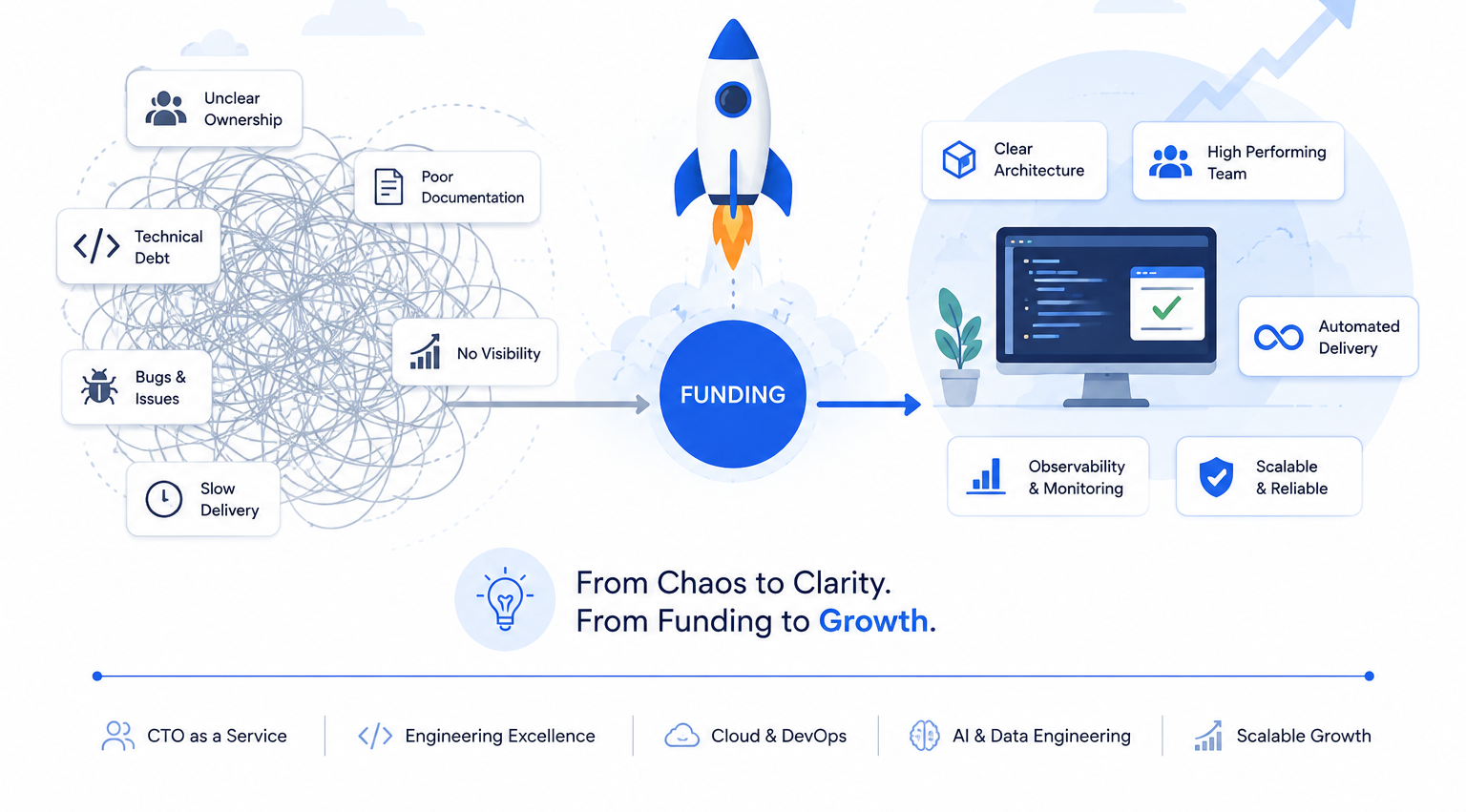
Funding removes your most obvious constraint: money. But money was never the thing keeping your engineering organized. Constraints force focus. Once that pressure lifts, teams tend to expand in every direction at once – more hires, more features, more infrastructure without the coordination to hold it together.
The result is added complexity without added structure. Communication overhead climbs, ownership gets fuzzy, and shortcuts pile up. Speed doesn’t disappear overnight. It leaks slowly, one unmanaged decision at a time.
Let’s look at where those leaks come from.
Mistake #1: Hiring too fast without an engineering structure
The pressure after a raise is real. Investors expect progress. So founders do the intuitive thing: they hire aggressively. More engineers should mean more output, right?
Not without structure. When you triple headcount in a quarter and drop people onto a team that has no defined roles, reporting lines, or shared practices, you don’t get three times the velocity. You get three times the chaos.
Why does hiring more engineers sometimes slow a startup down?
A few reasons show up again and again:
- Communication overhead explodes. Every new person adds connections. A team of 5 has 10 communication paths; a team of 15 has over 100. Coordination eats the time you thought you were buying.
- Duplicate work becomes normal. Without clear ownership, two engineers unknowingly solve the same problem in different ways.
- Nobody truly owns anything. When everyone is responsible for the codebase, no one is.
- Onboarding is an afterthought. New hires spend weeks guessing at how things work because documentation doesn’t exist.
- Practices drift. Everyone writes code their own way, reviews inconsistently, and tests when they feel like it.
Warning signs: onboarding takes months, senior engineers spend most of their day answering questions, and output per person drops as the team grows.
What to do instead: Hire in deliberate waves, not floods. Define team structure and ownership before the offers go out. Build a real onboarding process—documentation, a starter project, a buddy system. Establish coding standards and review practices early so new people inherit habits instead of inventing them.
CTO takeaway: Headcount is a lever, not a strategy. Structure is what turns hires into velocity. This is exactly where fractional or interim technical leadership (see our Fractional CTO offering) earns its keep—someone senior to design the org before the hiring spree, not after.
Mistake #2: Scaling the team without clear technical ownership
Closely related to hiring, but distinct enough to break your growth on its own: no one owns the important decisions.
In a five-person startup, ownership is implicit. Everyone knows who handles the database and who owns the payments flow. Add twenty people and that shared understanding evaporates. Decisions stall because nobody knows who gets to make them.
Who should own technical decisions as a startup scales?
Clear ownership means naming specific people responsible for specific areas and outcomes. That usually looks like:
- Tech leads owning particular systems, services, or product areas—responsible for design decisions and code quality within their domain.
- A CTO or head of engineering owning cross-cutting concerns: architecture direction, hiring bar, security posture, and the overall technical strategy.
- Product and engineering splitting responsibilities cleanly—product owns what and why, engineering owns how and when.
Practical example: A startup I advised kept missing deadlines because every architectural question went to the founder, who was buried in fundraising. We assigned three tech leads, gave each a clear domain, and set a simple rule: decisions inside your domain are yours to make. Delivery predictability improved within a month—not because the engineers changed, but because the decision-making did.
Without accountability, you get committees, endless debate, and features that drift because no single person owns the result. Name owners. Write it down. Let them decide.
Mistake #3: Ignoring technical debt while chasing features
“We’ll clean this up later” is the most expensive sentence in startup engineering.
Post-funding, the pressure to ship features is intense. So teams take shortcuts—skip tests, copy-paste instead of refactor, leave documentation for a quieter week that never comes. Each shortcut feels harmless. Together they compound like debt on a credit card.
When should a startup address technical debt?
The honest answer: continuously, and before it starts dictating your roadmap. Technical debt turns from an engineering annoyance into a business problem when:
- New features take progressively longer to ship.
- Small changes cause unexpected breakages elsewhere.
- Engineers are afraid to touch certain parts of the codebase.
- Bug counts climb while feature output falls.
- Onboarding new engineers to legacy code takes weeks.
Warning signs you’ve crossed the line: your team quotes “two weeks” for changes that should take two days, and every release comes with a wave of regressions.
What to do instead:
- Budget a fixed slice of every sprint for refactoring and cleanup—10% to 20% is a reasonable starting point.
- Treat tests and documentation as part of “done,” not optional extras.
- Track debt visibly so it’s a shared, deliberate decision—not a silent accumulation.
- Refactor the code you touch. Leave it a little better each time.
Debt isn’t inherently bad; taking it on knowingly to hit a milestone is fine. Pretending it doesn’t exist is what kills velocity. Solid practices around Software Development and code quality keep debt from becoming a tax on everything you build.
Mistake #4: Scaling the architecture too late
The architecture that got you to product-market fit was built to prove an idea, not to carry ten times the load. That’s correct—you should build an MVP quickly (our MVP Development approach is built around exactly that). The mistake is assuming MVP architecture will stretch to meet growth without a rethink.
What’s the difference between MVP architecture and growth architecture?
| Concern | MVP architecture | Growth architecture |
|---|---|---|
| Goal | Prove the idea fast | Handle scale reliably |
| Database | Single instance, minimal tuning | Read replicas, indexing, sharding as needed |
| APIs | Whatever ships fastest | Versioned, documented, rate-limited |
| Infrastructure | Manual, single environment | Automated, multi-environment |
| Caching & queues | Rarely present | Used to absorb load and smooth spikes |
| Reliability | Best effort | Monitored, with defined uptime targets |
| Security | Basic | Hardened, audited, access-controlled |
| Observability | Logs, maybe | Metrics, tracing, alerting |
When should a startup change its architecture?
Watch for these triggers:
- Response times climb as your user base grows.
- Your database becomes the bottleneck for nearly every request.
- Deploys are risky because everything is tightly coupled.
- Third-party integrations fail under load with no fallback.
- You can’t tell what’s happening in production without SSH-ing into a box.
The fix isn’t a dramatic rewrite—those usually fail. It’s incremental evolution: introduce caching and queues where they relieve pressure, plan database scalability before you hit the wall, and build in reliability, security, and observability as first-class concerns.
Mistake #5: Measuring engineering activity instead of product velocity
Once teams grow, leaders want visibility. So they start measuring—and often measure the wrong things.
Counting tickets closed, commits pushed, hours logged, or story points completed tells you how busy your team is. It says almost nothing about whether you’re delivering value. A team can be enormously busy and still ship little that matters.
What engineering metrics actually matter for startups?
Focus on outcomes, not activity:
| Vanity metric | Meaningful metric |
|---|---|
| Tickets closed | Release frequency |
| Commits pushed | Lead time for changes |
| Hours worked | Cycle time |
| Story points | Deployment reliability / change failure rate |
| Lines of code | Defect rate in production |
| Meetings held | Time to resolve production issues |
The four DORA metrics—deployment frequency, lead time for changes, change failure rate, and time to restore service—are a well-established starting point because they connect engineering directly to delivery.
But even those are means to an end. The metric that matters most is customer impact: are you shipping things that move the product and the business forward? Tie your engineering measurement to business outcomes, and you’ll stop rewarding motion for its own sake.
Mistake #6: Treating CI/CD, testing, and DevOps as later problems
Early on, deploying by hand and testing manually feels fine. It’s fast enough at small scale. But those manual processes don’t scale with your team—they become the bottleneck that throttles everything else.
Picture a growing team where every deploy is a manual, hold-your-breath event. Releases get batched because they’re painful, which makes each release bigger and riskier, which makes people even more nervous about deploying. That loop kills momentum.
How important is CI/CD for a scaling startup?
It’s foundational. The engineering practices that keep a scaling team fast include:
- Continuous integration and delivery (CI/CD) so code flows to production in small, safe increments.
- Automated testing so quality isn’t dependent on someone remembering to check.
- Deployment automation so releases are boring and repeatable.
- Infrastructure as Code (IaC) so environments are reproducible and versioned.
- Monitoring and observability so you find problems before customers do.
- DevSecOps so security is built into the pipeline, not bolted on later.
The goal is automation and reliability together—shipping faster without shipping more breakage. If deployments are still a source of stress, that’s a signal to invest in DevOps Consulting and before scale makes the problem unbearable.
Mistake #7: Scaling without a technical roadmap
Most startups have a product roadmap. Far fewer have a technical roadmap—and that gap shows up as constant firefighting.
A product roadmap says what you’ll build. A technical roadmap says whether your engineering can actually support building it. Without one, you make infrastructure and architecture decisions reactively, always a step behind the business.
What should a startup’s technical roadmap include?
A practical technical roadmap connects engineering to business goals and covers:
- Alignment with business goals and the product roadmap — what the company needs technically to hit its targets.
- Customer growth projections — the scale you’re planning for, not just today’s load.
- Engineering capacity — the people and skills you’ll need, mapped to a hiring plan.
- Infrastructure evolution — how your cloud and systems grow with demand.
- Security posture — what you’ll harden and when.
- Technical debt strategy — what you’ll pay down and what you’ll knowingly carry.
Think of it as the bridge between your business ambitions and your engineering reality. When those two are aligned, you stop being surprised by your own growth.
Is your engineering team ready to scale?
Use this checklist as a quick health check. If you can’t confidently tick most of these, you’ve found where to focus.
- Architecture can handle 5–10x current load without a rewrite
- Technical ownership is clearly assigned for each system and area
- Technical debt is tracked and actively managed
- Automated testing covers your critical paths
- CI/CD pipeline deploys reliably and often
- Cloud infrastructure scales without manual intervention
- Security practices are defined and enforced
- Monitoring and observability give real production visibility
- Documentation lets a new hire ramp up in days, not months
- Engineering processes (code review, standards) are consistent
- Team structure has clear roles and reporting lines
- Product and engineering are aligned on priorities
- Technical leadership owns architecture and strategy
A 90-day post-funding engineering framework
You don’t have to fix everything at once. Here’s a sequence I use with newly funded teams.
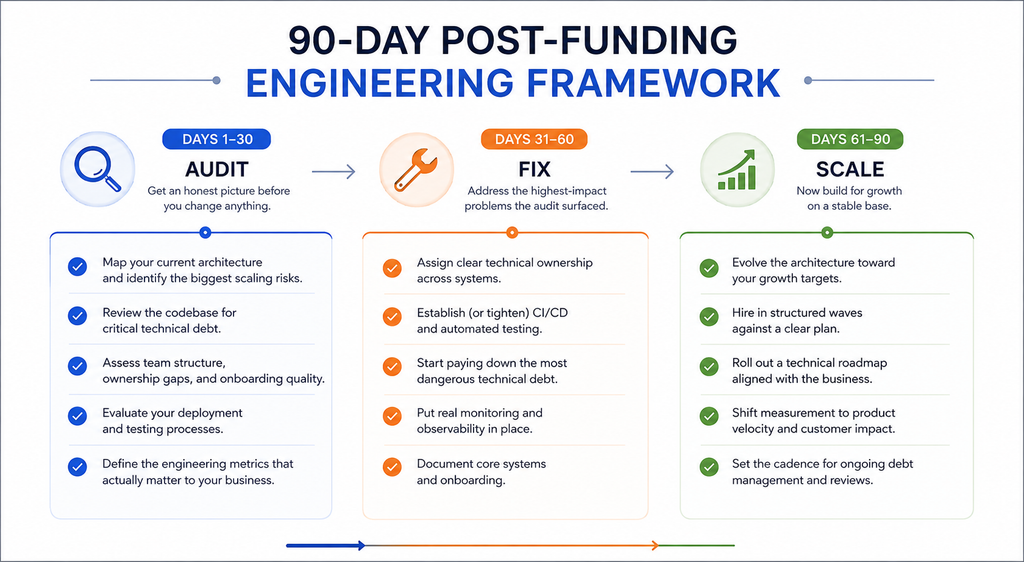
Days 1–30: Audit
Get an honest picture before you change anything.
- Map your current architecture and identify the biggest scaling risks.
- Review the codebase for critical technical debt.
- Assess team structure, ownership gaps, and onboarding quality.
- Evaluate your deployment and testing processes.
- Define the engineering metrics that actually matter to your business.
Days 31–60: Fix
Address the highest-impact problems the audit surfaced.
- Assign clear technical ownership across systems.
- Establish (or tighten) CI/CD and automated testing.
- Start paying down the most dangerous technical debt.
- Put real monitoring and observability in place.
- Document core systems and onboarding.
Days 61–90: Scale
Now build for growth on a stable base.
- Evolve the architecture toward your growth targets.
- Hire in structured waves against a clear plan.
- Roll out a technical roadmap aligned with the business.
- Shift measurement to product velocity and customer impact.
- Set the cadence for ongoing debt management and reviews.
Scaling after funding? Make sure your engineering foundation can support the growth
New funding buys you options. It doesn’t automatically buy you speed. The startups that pull ahead after a raise aren’t the ones that hire the fastest—they’re the ones that build the structure, ownership, and technical foundation to turn resources into real velocity.
Start with the checklist. Run the 90-day framework. Be honest about which of the seven mistakes you’re living with right now.
And if you’d rather not navigate it alone, this is precisely the moment where external technical leadership helps most—when you need architectural guidance, you’re scaling the engineering team, technical debt is slowing you down, you need a credible technology roadmap, engineering velocity is stalling, your DevOps and CI/CD need work, or you simply need CTO-level decision-making without a full-time hire.
At Enlight Lab, we help funded startups build engineering foundations that hold up under growth—through fractional CTO leadership, technical architecture, product engineering, cloud and DevOps, and beyond. If you’re scaling after funding, let’s make sure your foundation can carry where you’re headed.