It feels simple. It isn’t. Founders often frame it as “who can write the code for me,” but that’s the wrong lens: code is the easy part to outsource. The harder questions decide whether your company still has a functioning product in three years:
- Who owns the technical decisions when priorities conflict with reality?
- Who defines the architecture, and lives with the consequences of that choice?
- Who takes responsibility when the product needs to scale past its first thousand users?
- Who is still around after the MVP ships, when the real work begins?
- What happens if the technology itself becomes your competitive advantage?
A technical co-founder vs product engineering partner decision isn’t really about who codes fastest. It’s about ownership, timing, and how much of your company’s technical future you want to build in-house versus with outside expertise. This guide covers both options, plus two models founders often forget exist: the fractional CTO and the internal engineering team, so you can figure out what your startup actually needs right now.
What Is a Technical Co-Founder?
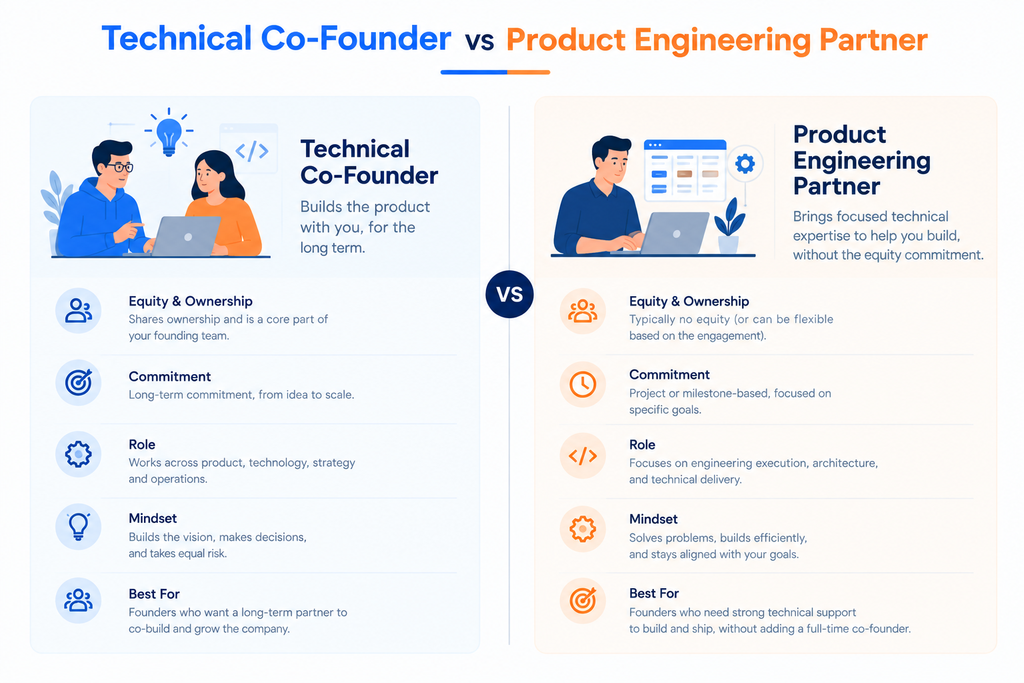
A technical co-founder is not “the person who builds the app.” That shorthand undersells the role: they’re a founding member who takes on long-term ownership of the technology, usually for meaningful equity rather than a market-rate salary. That ownership shows up as:
- Technology strategy. They help decide what gets built, in what order, and why.
- Architecture decisions. They choose the foundational structure of the product, decisions that are expensive to reverse later.
- Team building and technical culture. As the company grows, they typically hire, structure, and lead the engineering organization, and set code review and deployment norms.
- Security and scalability judgment. They’re accountable for the product holding up as usage grows, not just working in a demo.
- Investor and board conversations. They’re often the person answering “how defensible is your technology” in a fundraising room.
It helps to separate the roles founders sometimes lump together:
Developer → Engineering Lead → CTO → Technical Co-Founder
A developer executes tasks. An engineering lead manages people and delivery. A CTO owns technical strategy at an executive level, often as a hired, salaried role. A technical co-founder does all of that, plus carries founder-level equity, risk, and commitment. These titles are not interchangeable.
What Is a Product Engineering Partner?
A product engineering partner is a company or team you bring in on a commercial basis (contract, retainer, or dedicated team) to build and evolve your product. Good ones contribute across the full lifecycle:
Problem → Product Scope → Architecture → Development → Testing → Deployment → Iteration
In practice, that can include:
- Product and technical discovery, including pushing back on scope that doesn’t serve the goal
- UX/UI collaboration and architecture decisions suited to your stage and budget
- Software development across web, mobile, and backend, plus AI integration, cloud, and DevOps
- QA and testing discipline, and post-launch iteration based on real usage data
A traditional development vendor waits for requirements and executes them. A genuine partner helps shape those requirements, flags risk early, and stays accountable to outcomes. If your “partner” only ever asks “what do you want built” and never “why,” you’ve hired a vendor with a nicer name.
Technical Co-Founder vs Product Engineering Partner: A Direct Comparison
| Factor | Technical Co-Founder | Product Engineering Partner |
|---|---|---|
| Relationship | Long-term company relationship | Business/service relationship |
| Ownership | Usually equity-based | Usually contract/commercial |
| Technical strategy | High, direct involvement | Can provide strategic guidance |
| Product development | Directly involved, hands-on | Core responsibility |
| Engineering hiring | Usually owns it long-term | Partner supplies the team |
| Internal team building | Yes, over time | Optional, can transition later |
| Speed to MVP | Depends on recruiting timeline | Often faster to start |
| Long-term ownership | Internal, by default | Must be defined contractually |
| Cost structure | Salary plus equity | Project, team, or retainer fees |
| Commitment | Company-level | Contract-level |
| Scalability | Builds internal capability over time | Can scale team through the partner |
| Technical leadership | Usually deep and continuous | Depends heavily on the partner |
| Best fit | Long-term technology ownership | Product execution and acceleration |
This table is a starting point, not a rulebook. Plenty of real companies blend both models, and the right column can shift as your startup grows.
The Question Founders Should Ask First
Before choosing a model, get specific about the actual problem. “We need technical help” is too vague to act on.
- “I don’t know what technology we need.” A strategy gap, not an execution gap. Points toward a CTO, fractional CTO, technical advisor, or technical co-founder.
- “We know what we need but can’t build it.” An execution gap. A product engineering partner, dedicated development team, or targeted hires can close it without solving the strategy question first.
- “We need both technical strategy and execution.” Common for first-time founders. Realistic combinations include a fractional CTO paired with an engineering partner, or a technical co-founder leaning on an external partner for extra capacity.
- “Technology itself will become our competitive advantage.” If your differentiation lives inside proprietary algorithms, unique data pipelines, or deep technical IP, deeper internal technical ownership starts to matter more than speed to launch.
When Should You Consider a Technical Co-Founder?
A technical co-founder tends to make sense when:
- Technology is genuinely core to the business, not just the delivery mechanism for it
- The product requires continuous technical innovation, not a one-time build, or involves complex, proprietary technology
- AI or ML sits at the center of your differentiation, or you expect to build a substantial, long-term engineering organization
- Major technical decisions will meaningfully shape the company’s direction for years
Now the part founders skip: needing developers does not automatically mean you need a technical co-founder. Giving away 15 to 50 percent of your company (the range industry commentary commonly cites for a genuine technical co-founder role) is a permanent decision to solve what is often a temporary problem: you need an MVP built. If the real need is execution capacity, not long-term ownership, a co-founder relationship can cost far more than it solves.
When Should You Consider a Product Engineering Partner?
A product engineering partner tends to be the better fit when:
- You’ve already validated the problem, and requirements are reasonably clear
- You need to move on an MVP without a long recruiting cycle
- You need specialized skills (AI, cloud, data engineering, DevOps) you don’t have in-house
- You have an existing team but need predictable capacity to accelerate a specific initiative
A strong engineering partner can shorten the distance between Idea → Scope → Prototype → MVP → Production, largely by removing the recruiting bottleneck. Be wary of anyone promising a specific multiple of speed without qualifying it; real timelines depend on your product’s complexity and how well-defined the scope is going in.
What About a Fractional CTO?
This is the option founders most often forget exists: the middle ground between “find a technical co-founder” and “just hire a development company.” A fractional CTO is a senior technical leader who works part-time or on a defined engagement, without full-time employment or founder equity. They typically provide:
- Technical strategy, roadmap direction, and architecture decisions
- Technology and vendor evaluation
- Engineering team structure and hiring guidance
- AI adoption, cloud strategy, and security or compliance considerations
- General technical governance, the guardrails that keep decisions consistent over time
A workable model for many early founders looks like this:
Founder → Fractional CTO → Product Engineering Partner
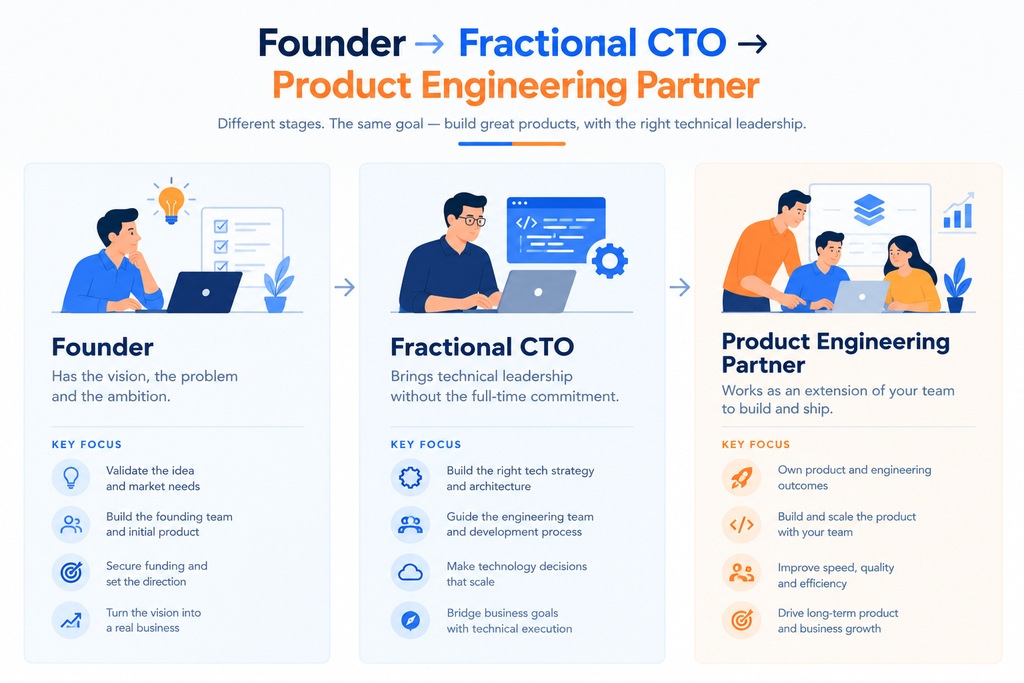
The fractional CTO sets direction and evaluates the engineering partner’s work, so the founder isn’t left assessing technical decisions alone. This isn’t right for every company, but for a non-technical founder who needs real technical judgment without a full-time hire or an equity grant, it’s often underused.
The Cost Question
Don’t compare these options on sticker price alone; compare the full economic structure. Technical co-founder costs typically include equity (often double digits), possibly a below-market salary, and the recruiting time to find the right person. Product engineering partner costs typically include development fees, team or retainer costs, infrastructure, QA, and product management. Fractional CTO costs typically run as a monthly advisory fee or scoped engagements, billed lighter than a full-time hire.
The lowest number on the invoice isn’t necessarily the cheapest option over the life of the company. Equity given away too early is expensive in ways that don’t show up until your next funding round; a cheap development shop that produces unmaintainable code is expensive the moment you need to change anything.
What Founders Often Get Wrong
Hiring a technical co-founder because “we need someone to code,” or hiring a development company before defining the product. Coding capacity is a solvable, temporary problem; equity is permanent, so don’t trade a permanent stake for a temporary execution gap. And scope drift is expensive: validate the problem and rough out the product before bringing in build capacity, or you’ll pay to build the wrong thing efficiently.
Assuming an engineering partner replaces technical leadership. Even the best partner needs someone on your side making final calls on priorities and trade-offs. That’s still your job, or a fractional CTO’s, not the partner’s.
Optimizing only for the cheapest development rate, or building a large team too early. The lowest hourly rate rarely accounts for rework or technical debt, and headcount is a fixed cost regardless of whether your assumptions turn out right. Validate first, scale second.
Treating architecture as a one-time decision, or ignoring AI’s impact on engineering economics. The right architecture for 100 users isn’t right for 100,000, and should be revisited as the product grows. AI coding tools are also changing how teams work, though not in the simple “do more with fewer people” way it’s often marketed.
How AI Is Changing This Decision
AI coding assistants are genuinely reshaping software development, but the picture is more complicated than the hype suggests. A widely cited 2025 randomized controlled trial from METR tested experienced open-source developers on real tasks in mature codebases, with AI tools enabled for half the tasks and disabled for the other half. The result: developers were about 19% slower with AI tools than without them, the opposite of the 20 to 40% speedup researchers, experts, and the developers themselves had predicted. Even after finishing, they still believed they’d been 20% faster, not slower.
That doesn’t mean AI coding tools are useless. Other research shows a more nuanced pattern: individual output metrics like lines of code can rise sharply with AI assistance, while organization-level metrics like lead time often stay flat or worsen because the bottleneck simply moves downstream. Separate telemetry from thousands of developers found AI-assisted code tends to arrive in larger pull requests with more bugs per developer, shifting strain onto code review rather than removing it.
The practical takeaway for founders: AI can reduce the cost and time of producing code. It does not eliminate the need for technical decisions. Someone still has to own:
- Architecture that AI-generated code has to fit into, and product decisions about what’s worth building
- Security review of AI output, which doesn’t inherit human judgment about risk
- Testing discipline, arguably more important now that review is the new bottleneck
- Technical debt management, since AI tools can generate debt as fast as they generate features
- Governance over how and where AI tools get used in your codebase
Be skeptical of anyone claiming “one developer with AI can replace an entire engineering team.” The evidence doesn’t support that, especially for experienced teams on real codebases. What AI does change is team structure: founders may need fewer junior developers doing repetitive work, but just as much, arguably more, senior judgment reviewing what ships. That shifts the relative importance of technical leadership up, not down.
A Simple Decision Framework for Founders
Work through these in order:
1. Is technology a core competitive advantage? Yes → lean toward deeper internal technical ownership. No → continue.
2. Do you already have strong technical leadership? Yes → a product engineering partner can help you execute faster. No → bring in a fractional CTO or advisor before you start building.
3. Do you need to validate the product quickly? Yes → a focused, lean product engineering team is usually the fastest path.
4. Will you eventually build an internal engineering organization? Yes → structure any partner relationship for knowledge transfer from day one.
5. Is the product technically complex? Yes → prioritize getting architecture and technical leadership right before scaling development capacity.
Revisit this checklist every six months. The right answer at pre-seed is rarely the right answer at Series A.
Technical Co-Founder + Product Engineering Partner Can Coexist
The decision doesn’t have to be either/or. Under Technical Co-Founder + Product Engineering Partner, the co-founder owns technology strategy, architecture, and internal culture, while the partner supplies development capacity and specialized expertise (QA, DevOps, cloud, AI) the co-founder doesn’t have time to build in-house. This is common in the early stages, when a co-founder is stretched thin across strategy, hiring, and hands-on building at once, and it lets them stay focused on the decisions only they can make.
What to Look for in a Product Engineering Partner
Before signing anything, evaluate:
- Product thinking and architecture capability, not just staffing
- Real, verifiable AI, cloud, security, QA, and DevOps experience
- Communication style, transparency, and documentation quality
- Clear code and IP ownership terms, and a knowledge transfer plan if you’ll build in-house later
- Post-launch support and the ability to scale the team up or down
Questions to Ask Before Choosing
- Do we need technical leadership, or engineering capacity?
- Is technology central to our competitive advantage, or a delivery mechanism for one?
- What technical decisions must stay under founder or company ownership?
- What does our MVP actually require, stripped of nice-to-haves?
- Do we expect to hire an internal engineering team eventually, and when?
- Who owns the architecture, the source code, and the IP, in writing?
- How will technical debt be tracked, and how will AI-generated code be reviewed?
- How will we define and measure success for this engagement?
Final Decision Matrix
| Startup Situation | Potentially Suitable Model |
|---|---|
| Technology is core IP | Technical co-founder or internal technical leadership |
| Clear product, need execution | Product engineering partner |
| No technical leadership in-house | Fractional CTO or technical advisor |
| Need strategy and execution together | Fractional CTO plus engineering partner |
| Scaling an engineering organization | Internal engineering leadership and team |
| Need short-term specialized expertise | Product engineering partner |
| Early validation stage | Lean product engineering approach |
Treat these as directional, not prescriptive; your funding situation, team, and risk tolerance can shift any of these.
The Enlight Lab Perspective
Founders don’t always need to immediately build a large engineering organization. What they usually need is the right combination of product clarity, technical leadership, and engineering execution for their current stage.
Enlight Lab works with startups as a product engineering partner across MVP development, AI product development, custom software, AI integration, cloud architecture, data engineering, DevOps, and broader technical strategy. The goal isn’t to replace the technical judgment your company needs long-term; it’s to support the right capacity at the right moment, whether that’s accelerating an existing team, standing up an MVP, or helping you reach product-market fit before committing to a full internal organization.
Before deciding whether you need a technical co-founder, an internal team, or a product engineering partner, start by defining what technical problem you’re actually trying to solve. Enlight Lab is happy to discuss your specific product and technical requirements.