AI agents work in demos. The gap between a working demo and a reliable production system is where most enterprise projects die.
Gartner’s January 2026 analysis confirmed that at least 50% of generative AI projects are abandoned after proof of concept – not because the underlying models are incapable, but because organizations consistently underestimate what it takes to move from a controlled test environment to production reality. Digital Applied’s analysis of enterprise deployments across 2024 and 2025 puts the failure rate even higher: 88% of AI agent projects never reach production operation. McKinsey’s 2025 State of AI report found fewer than 20% of AI pilots scale to production within 18 months.
The average cost of a failed AI agent project is $340,000 in direct expenses. Factor in opportunity cost and organizational confidence erosion, and that figure climbs past $650,000.
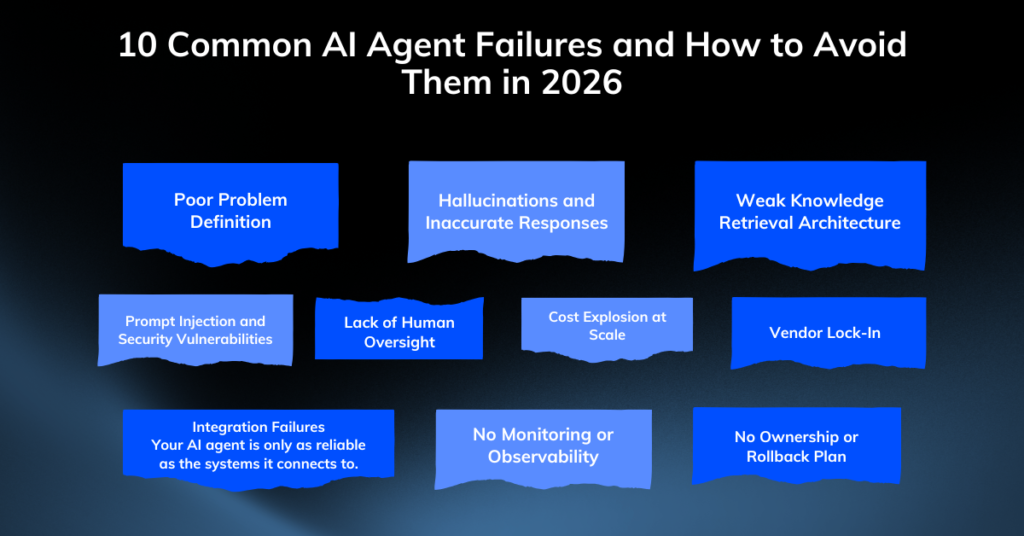
This is not a technology problem. The models are capable. The tooling has matured. The failure is in the surrounding architecture – scoping, data infrastructure, security design, integration, governance, and operational discipline. Here are the 10 most common AI agent failures and what to do about each one.
Why AI Agent Projects Fail More Often Than Companies Expect
The root cause of most AI agent failures is a mismatch between what gets built in development and what production actually demands.
A demo runs on curated data, a narrow use case, and a small number of carefully constructed inputs. Production runs on messy real-world data, unpredictable user behavior, legacy system constraints, and enterprise security requirements that weren’t part of the original brief. That gap is rarely accounted for in planning timelines or budgets.
AI agents are also fundamentally different from simpler AI deployments like text classification or recommendation models. Agents interact with multiple systems, take sequential actions, and make decisions that cascade. When a classification model encounters bad data, it misclassifies one record. When an agent encounters bad data, it can chain multiple incorrect conclusions, take several wrong actions, and corrupt downstream systems before anyone notices. The error propagation multiplier is significantly higher.
Understanding why agents specifically fail and at what stage – is the first step toward shipping AI that works.
Failure #1: Poor Problem Definition
The most expensive AI project is the one solving the wrong problem.
Building AI for the sake of AI has accelerated in the last two years. Teams deploy agents because competitors are deploying agents, not because they’ve identified a workflow where autonomous reasoning delivers measurable value. The result is AI attached to low-impact tasks, burning engineering time and budget with no clear ROI story.
The right use cases for AI agents share three characteristics: they involve repetitive multi-step reasoning, they have access to reliable structured data, and the cost of an incorrect outcome is recoverable. Customer support triage, internal document retrieval, code review assistance, and sales pipeline qualification are examples of workflows that satisfy these criteria.
Workflows that require nuanced human judgment, involve regulatory exposure on every decision, or depend on unstructured institutional knowledge are poor fits for autonomous agents in their current form
Failure #2: Hallucinations and Inaccurate Responses
An agent that confidently provides wrong answers is worse than no agent at all.
Hallucinations occur when a large language model generates plausible-sounding responses that are factually incorrect or unsupported by the source data. This isn’t a bug in the conventional sense – it’s a structural characteristic of how LLMs generate outputs. Misinformation ranks as LLM09 in the OWASP LLM Top 10 (2025), and for enterprise deployments, it represents one of the highest-stakes failure modes.
The business impact is direct. An AI agent that tells a customer the wrong refund policy, quotes an incorrect price, or references an outdated compliance requirement doesn’t just produce a bad answer it produces a customer service incident, a potential liability, and an erosion of user trust that takes months to recover.
Retrieval-Augmented Generation (RAG) reduces hallucination risk by grounding agent responses in specific, verified source documents rather than relying entirely on model weights. But RAG is not a complete solution on its own. The quality of the documents being retrieved, the accuracy of the retrieval mechanism, and the structure of the prompt all affect output reliability.
For high-stakes workflows, human review of agent outputs before they reach end users remains the most reliable safety net. Build human-in-the-loop checkpoints into any agent workflow where an incorrect answer carries real cost.
Failure #3: Weak Knowledge Retrieval Architecture
Garbage in, garbage out and with agents, the garbage propagates.
Most RAG implementations fail not because RAG is the wrong approach, but because the document quality, chunking strategy, and retrieval pipeline are built too quickly. Teams dump all available documentation into a vector database and assume the model will figure out relevance. It won’t.
Poor document quality is the most common upstream cause of retrieval failures. Outdated content, duplicate records, inconsistent formatting, and documents without clear semantic structure all reduce retrieval accuracy. A vector similarity search returns the most statistically similar chunks not the most accurate ones when the source material is noisy.
Chunking strategy matters more than most teams expect. Chunks that are too large flood the context window with irrelevant content. Chunks that are too small lose surrounding context needed for accurate interpretation. The right chunking approach depends on document type, query patterns, and context window constraints of the model being used.
Before deploying a retrieval pipeline to production, run structured retrieval accuracy tests against a representative sample of real user queries. If the agent can’t reliably surface the right information in testing, it won’t do it in production either.
Failure #4: Integration Failures
Your AI agent is only as reliable as the systems it connects to.
Integration complexity is the single largest gap between AI agent demos and production deployments. A demo typically runs against clean API samples, well-documented endpoints, and controlled authentication flows. Production connects to CRM systems with thousands of custom fields, ERP platforms built on legacy architecture, and internal tools with unofficial APIs and minimal documentation.
The Composio 2025 analysis identified three specific integration failure patterns:
- “Dumb RAG”: flooding context with unstructured data from every connected system
- “Brittle Connectors”: fragile API integrations that break under real-world conditions
- “Polling Tax”: agents that repeatedly query systems for updates instead of using event-driven architecture, burning through API rate limits and introducing latency
Authentication failures are particularly common in enterprise environments. OAuth token expiry, inconsistent permission models across systems, and undocumented rate limiting behavior all create integration failures that appear sporadically rather than consistently making them difficult to diagnose and reproduce.
The fix is to require proof-of-concept integration testing for every non-trivial system before committing to the project scope. A two-day technical spike that attempts real authentication and a sample API call tells you more than any amount of vendor documentation.
Human handoff failures also belong in this category. When an agent escalates to a human agent, the receiving human needs full context conversation history, the customer’s data record, and the reason for escalation. Agents that hand off without this context transfer incomplete work and create frustrating experiences for both customers and agents.
Failure #5: Prompt Injection and Security Vulnerabilities
Your agent can be weaponized against you without a single line of your code being compromised.
Prompt injection is ranked LLM01 in the OWASP LLM Top 10 (2025) the highest-priority security risk for LLM applications. According to OWASP, a prompt injection vulnerability occurs when user input alters the model’s behavior in unintended ways, potentially bypassing safety measures, disclosing sensitive information, enabling unauthorized access, or executing arbitrary commands in connected systems.
There are two forms. Direct prompt injection is when a user deliberately crafts input to manipulate the agent’s behavior. Indirect prompt injection is when malicious instructions are embedded in external content the agent processes a document it summarizes, a web page it retrieves, or a file a user uploads.
For enterprise agents with access to internal systems, prompt injection is not an edge case. It’s a predictable attack vector that requires deliberate mitigation. The OWASP LLM Top 10 recommends five core controls: constrain model behavior through specific system prompt instructions, validate expected output formats, implement input and output filtering, enforce least-privilege access (LLM06: Excessive Agency), and require human approval for high-risk actions.
Sensitive information disclosure (LLM02) is a related risk. Agents trained on or given access to proprietary data can inadvertently surface that data in responses if retrieval boundaries aren’t explicitly enforced.
Digital Applied’s analysis found that security review kills more agent projects than security vulnerabilities do. Most blocked projects don’t have actual vulnerabilities they lack the audit log infrastructure, access control documentation, and data handling specifications that enterprise security teams require before granting production access. Build security architecture in parallel with development, not as a final gate.
Failure #6: Lack of Human Oversight
Fully autonomous agents in enterprise environments are not a feature. They’re a liability.
The appeal of full autonomy is obvious no human bottleneck, lower operating cost, 24/7 availability. The problem is that LLMs behave unexpectedly in production. This is not a defect. It’s a structural characteristic of systems that reason across varied, unpredictable inputs.
Without human-in-the-loop checkpoints, a single unexpected behavior can propagate across hundreds of interactions before anyone detects it. AI agent errors don’t work like human errors. A human agent gives one customer wrong information. An AI agent with model drift can deliver the same wrong information across every conversation until the model is retrained and redeployed.
Human-in-the-loop design doesn’t mean humans review every output. It means the system is architected to escalate to human review when confidence thresholds are low, when actions carry elevated risk, or when the conversation falls outside the agent’s defined scope.
Glovo, using GetVocal’s hybrid human-AI model, reported a 35% increase in deflection rate and a five-fold increase in uptime within weeks of deployment (company-reported, Retail Tech Innovation Hub, 2025). The architecture combined AI handling of routine interactions with supervisor visibility into live conversations and the ability to intervene at any point.
Failure #7: Cost Explosion at Scale
The economics that made sense in testing collapse at production volume.
LLM inference costs are negligible in development. At scale, they become the primary operating cost driver of your AI system and most teams don’t see it coming until the first month’s invoice arrives.
The failure pattern is consistent: an agent processes 100 requests during testing at minimal per-call cost. In production, it processes tens of thousands of requests per month with longer context windows reflecting real user inputs, and the per-call cost multiplies accordingly. When the actual cost is presented to finance, the ROI model breaks down and the project is suspended.
Gartner identifies escalating total cost of ownership as one of five critical failure points in GenAI projects, noting that organizations consistently underestimate operational expenses because they lack visibility into how costs scale. The per-token cost that appears trivial in proof-of-concept becomes a budget problem when multiplied across enterprise usage volumes.
The mitigation strategy involves three practices: model routing (directing simpler sub-tasks to smaller, cheaper models rather than frontier models), prompt caching (reducing redundant API calls for repeated context), and context window discipline (ensuring production inputs are tested at realistic lengths, not sanitized test samples).
Failure #8: Vendor Lock-In
Single-model dependency is technical debt with a vendor’s face on it.
Organizations that build AI agents tightly coupled to one model provider’s API create a fragile architecture. Model providers change pricing, deprecate versions, introduce rate limits, and shift capability profiles. When your entire agent depends on a specific model’s behavior, every provider-side change becomes your engineering problem.
Model-agnostic architecture separates your business logic from the specific model being called. Abstraction layers whether built in-house or through platforms designed for this purpose allow model substitution without rewriting core agent logic. This also enables cost optimization: routing specific task types to the cheapest capable model rather than sending every call to the same frontier model.
The practical implication for enterprise buyers is to evaluate AI agent platforms based on whether they support multi-model routing and whether the vendor’s architecture allows you to switch underlying models without rebuilding the system from scratch.
Failure #9: No Monitoring or Observability
Model drift is a consistent production failure mode. It occurs when the statistical properties of inputs or the model’s behavior shift over time, creating a widening gap between what the agent was validated to do and what it actually does in production. Without detection mechanisms, drift compounds silently.
The monitoring infrastructure required for production AI agents includes task success rate tracking by workflow type, human override rate as a quality signal, latency and cost per task, anomalous action log review, and baseline behavior comparison for drift detection.
Most teams deploy agents without this infrastructure in place. The result is that failures surface through customer complaints and downstream system errors rather than through proactive detection by the time the problem is visible to the business, it has already cost trust, revenue, or both.
The fix is to treat observability as a launch requirement, not a post-launch nice-to-have. An agent without a dashboard tracking these five signals from day one is an agent operating blind.
Failure #10: No Ownership or Rollback Plan
The ninth failure mode above explains why agents drift undetected. This failure explains why, even when drift is detected, organizations often can’t act on it fast enough.
Many AI agent deployments have a clear owner during the build phase a project lead, a vendor team, a steering committee and no clear owner once the system goes live. Responsibility diffuses across IT, the business unit that requested the agent, and the vendor who built it. When something goes wrong, the first 48 hours are spent figuring out who has the authority to pause the agent, not fixing the problem.
This is compounded by the absence of a rollback plan. Teams plan the forward path build, test, launch in detail, but rarely plan the reverse path: what happens if the agent needs to be disabled, downgraded to human-only, or rolled back to a previous version while a fix is developed. Without a pre-defined rollback procedure, an incident escalates from a technical problem into an organizational scramble.
A credible operating model assigns a named owner for the agent post-launch, defines who has authority to pause or disable it, and documents a tested rollback procedure before the system goes live not after the first incident makes the gap obvious.
The 10 Failures at a Glance
| # | Failure | Primary Fix |
|---|---|---|
| 1 | Poor problem definition | Define a measurable 30-day success outcome before building |
| 2 | Hallucinations | Ground responses in RAG; add human review for high-stakes outputs |
| 3 | Weak retrieval architecture | Clean source documents; test chunking against real queries |
| 4 | Integration failures | Run a 2-day technical spike on real auth and APIs before scoping |
| 5 | Prompt injection | Apply OWASP’s 5 core controls; build security in parallel, not last |
| 6 | Lack of human oversight | Define escalation thresholds and rules before deployment |
| 7 | Cost explosion at scale | Model route, cache prompts, test costs at 1x/5x/10x volume |
| 8 | Vendor lock-in | Build model-agnostic architecture with abstraction layers |
| 9 | No monitoring | Track success rate, override rate, latency, cost, and drift from day one |
| 10 | No ownership or rollback plan | Name a post-launch owner and test a rollback procedure pre-launch |
Final Thoughts
None of these 10 failures are inevitable. They’re predictable, well-documented patterns which means they’re preventable with the right scoping, architecture, and governance decisions made before launch rather than after an incident.
The organizations that succeed with AI agents aren’t the ones with access to better models. Every serious vendor is building on the same handful of frontier LLMs. The organizations that succeed are the ones who treat security, monitoring, cost discipline, and ownership as part of the build, not as cleanup after the proof of concept impresses a steering committee.
At Enlight Lab, we scope every AI agent engagement against this exact failure list before writing a line of code. If you’re evaluating whether your AI agent project is built to survive contact with production, we’re glad to walk through it with you.