The core difference between an AI project and an AI strategy: a project asks ‘can we build this?’ A strategy asks ‘should we build this, and what does success look like twelve months from now?’
A credible enterprise AI strategy covers six dimensions: business objectives, data readiness, technology architecture, talent and skills, governance and risk, and operating model. Weakness in any one of those dimensions will stall your program regardless of how strong the others are.
At Enlight Lab, we have seen organizations skip the strategy entirely and spend eighteen months building capabilities they could not deploy because governance was never established. The eight phases below exist to prevent that outcome.
Before you build anything, you need an honest picture of where you stand. Most organizations overestimate their readiness in strategy and underestimate their gaps in data, infrastructure, and talent.
According to Deloitte’s State of AI in the Enterprise 2026, 42% of companies believe their AI strategy is highly prepared. Far fewer feel confident about infrastructure, data quality, talent, and risk management. Strategy confidence without operational readiness produces failed programs.
How mature is your data infrastructure?
Rate your organization on data completeness, accuracy, accessibility, and lineage. If your teams cannot answer basic questions about where a data point came from and how it has been transformed, your models will produce unreliable outputs. Data maturity is the single biggest predictor of successful AI deployment.
Is your infrastructure ready to support AI workloads?
Evaluate compute capacity, cloud architecture, and integration layers. Legacy systems that cannot expose clean APIs create integration nightmares. Real-time AI use cases require infrastructure that most on-premise environments cannot support without significant rework.
Where are your talent and skills gaps?
IBM’s Global AI Adoption Index found that limited AI skills and expertise is the leading barrier to deployment, cited by 33% of enterprises. Map your current capabilities against what your roadmap will require. Identify which skills you will hire, which you will train, and which you will source through partnerships.
What governance structures are already in place?
Review your existing data governance, risk management, and compliance frameworks. These are the foundation your AI governance layer will sit on. Deloitte reports that only one in five companies has a mature governance model for autonomous AI agents. If your governance is weak today, it will become a deployment blocker tomorrow.
What regulatory requirements apply to your AI use cases?
Financial services, healthcare, and public sector organizations face specific AI regulations that vary by jurisdiction including the EU AI Act, HIPAA, and sector-specific model risk management guidelines. Identify these before development begins. Retrofitting compliance into a deployed model is expensive and sometimes impossible.
Not every AI idea deserves funding. Your job is to find the opportunities where AI delivers measurable value quickly enough to build internal confidence and where complexity is low enough to execute cleanly.
Use Case Identification and Prioritization
Use case prioritization framework
Score each potential use case against two dimensions: business value (revenue impact, cost reduction, risk mitigation, customer experience) and implementation complexity (data readiness, technical feasibility, integration requirements, regulatory exposure).
| Category | Description | Timeline | Example |
|---|---|---|---|
| Quick Wins | High value, low complexity | 0–6 months | AI-assisted customer support routing |
| Strategic Initiatives | High value, high complexity | 6–18 months | Predictive supply chain optimization |
| Experimental Projects | Lower value, exploratory | Ongoing | Generative AI for internal knowledge retrieval |
| Deprioritize | Low value, high complexity | Defer or eliminate | Custom model builds for marginal use cases |
Start with quick wins. They generate ROI data, build stakeholder confidence, and fund the strategic initiatives that follow.
How do you estimate ROI for an AI use case before building it?
Identify the baseline metric cost per transaction, time per process, and error rate. Project the improvement AI will deliver and attach a dollar value. Be conservative: a 20% improvement you can actually demonstrate beats a 60% projection nobody believes.
Connect each use case directly to a P&L line. AI programs that cannot show a path to EBIT impact do not survive budget reviews. McKinsey reports that only 39% of organizations currently report any EBIT contribution from AI. The ones that do have built business case discipline from the start.
Enterprise AI Governance Framework
Governance is not a compliance checkbox. It is the operating system your AI program runs on.
Without governance, your legal team will block production deployments. Your customers will not trust the outputs. Your regulators will intervene. Build governance before you need it not after it breaks something.
Deloitte’s 2026 report found that enterprises where senior leadership actively shapes AI governance achieve significantly greater business value than those delegating it to technical teams alone.
Your governance framework must address five areas:
- Responsible AI principles: Define your standards for fairness, explainability, and accountability. Codify them in a policy document that every AI project team reviews and accepts before work begins.
- Security policies: Specify how AI models handle sensitive data, what access controls exist, and how adversarial inputs, including prompt injection, the OWASP #1 AI security risk, are detected and blocked.
- Compliance controls: Map each use case to applicable regulations. Assign a named compliance owner for every production deployment.
- Human oversight requirements: Define where humans must remain in the loop. Autonomous AI decisions in high-stakes domains require explicit override mechanisms and complete audit trails.
- Model monitoring standards: Specify how often models are evaluated for drift, bias, and performance degradation. Set thresholds that trigger retraining or shutdown automatically.
Data Foundation and Infrastructure
Your AI strategy is only as good as the data underneath it. This phase is where most enterprises discover they have significantly more work than expected.
Data quality remediation
Audit your core data assets for the use cases you have prioritized. Identify gaps in completeness, consistency, and timeliness. Fix these before you start training or retrieval pipelines, not during.
Data pipelines and integration
Production AI runs on real-time or near-real-time data. If your data pipelines batch-load overnight, your AI systems will operate on stale inputs. Evaluate your current ETL and streaming infrastructure against the latency requirements of each use case.
Data ownership and stewardship
Assign clear ownership for every data domain your AI program will touch. Ownership disputes create delays and governance failures. Establish data stewards who are accountable for quality, access, and lineage documentation.
Data architecture for AI workloads
Modern enterprise AI architectures require three foundational components:
- Feature store: Reusable, versioned model inputs that eliminate duplicate engineering work across use cases.
- Vector database: Semantic search and retrieval-augmented generation (RAG) capability, enabling chatbots and agents to retrieve accurate, current information from your proprietary knowledge base.
- Data lakehouse: Unified architecture supporting both analytical and operational workloads without duplicating storage or ETL pipelines.
Technology Selection
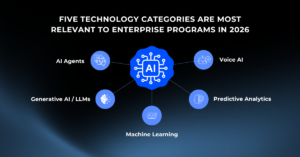
Technology selection is where organizations get distracted by vendor marketing. The right technology is the one that solves the specific problem you identified in Phase 2, integrates cleanly with your data infrastructure, and can be governed within your framework.
Three requirements every pilot must establish before development begins:
- Pre-agreed KPIs: Define what success means numerically before anyone writes a line of code. A 20% reduction in processing time. A 15% increase in first-contact resolution. A 10% reduction in forecast error. Without a pre-agreed threshold, stakeholders will evaluate pilots on gut feel and the results will be disputed regardless of the outcome.
- Named ownership: Identify the business owner who will champion production deployment and the technical owner who will maintain the system. Without both committed before the pilot begins, you will exit with a working model and no clear path forward.
- Production budget confirmed: A pilot that costs $200,000 to run will cost significantly more to productionize, monitor, and maintain. Confirm the organization is willing to fund the next phase before investing in the current one.
Production Deployment at Scale
This is the hardest phase. It is where most enterprise AI programs stall. The gap between a working pilot and a production system is not technical it is operational.
Production requires automated retraining pipelines, monitoring dashboards, incident response playbooks, cost controls, and change management for the humans whose workflows are changing. MLOps and LLMOps are the disciplines that make this transition reliable.
Key capabilities required for production deployment:
- Model monitoring: Track performance, data drift, and output quality continuously. Set automated alerts when metrics degrade past defined thresholds. Without this, failures surface through customer complaints rather than proactive detection.
- Cost optimization: AI inference costs can scale unexpectedly. IDC projects enterprise AI investment rising from $307 billion in 2025 to $632 billion by 2028. Without cost governance at the use-case level, individual deployments can consume budget faster than their ROI justifies.
- Scalability planning: Size your infrastructure for peak load, not average load. Agentic workloads can consume 10 to 50 times the compute of a simple query. Design for the traffic you will have, not the traffic you have today.
- Rollback capability: Every production deployment needs a tested rollback path. Models degrade. Use cases change. Requirements shift. You need to be able to revert cleanly without triggering a crisis response.
AI Center of Excellence
A Center of Excellence (CoE) is the organizational structure that makes your AI strategy self-sustaining. Without it, every new initiative starts from scratch. With it, your organization compounds its capabilities over time.
Core functions of an enterprise AI CoE:
- Governance and standards: Maintains the AI governance framework, updates policies as regulations evolve, and reviews new use cases for risk and compliance alignment.
- Tooling and infrastructure: Owns the shared platforms, model libraries, and data infrastructure that business units draw on eliminating duplicate build work across the organization.
- Education and enablement: Builds AI literacy across the organization. Deloitte reports that 53% of organizations are prioritizing AI fluency training as their primary talent response to AI adoption.
- Use case pipeline management: Maintains a prioritized backlog of AI opportunities, tracks ROI on deployed systems, and allocates resources across the portfolio based on performance data rather than politics.
- External partnerships: Manages relationships with AI vendors, research institutions, and implementation partners. Enlight Lab’s AI consulting practice frequently operates as an embedded extension of enterprise CoE teams during the build phase, providing specialized capability without permanent headcount.
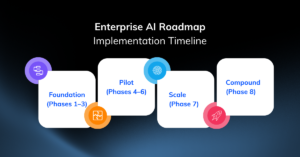
Enterprise AI Roadmap: Implementation Timeline
| Phase | Timeline | Key Activities | Success Criteria |
|---|---|---|---|
| Foundation(Phases 1–3) | 0–3 months | AI readiness assessment, governance framework design, data audit, use case prioritization | Readiness score documented, prioritized use case backlog, governance policy approved |
| Pilot(Phases 4–6) | 3–6 months | Launch 2–3 quick-win pilots, build data pipelines for priority use cases, stand up CoE structure | KPIs met in pilot, production plan approved, CoE roles filled |
| Scale(Phase 7) | 6–12 months | Move pilots to production, expand data infrastructure, deploy MLOps tooling, launch second wave of use cases | 2+ production deployments live, measurable EBIT contribution, monitoring dashboards operational |
| Compound(Phase 8) | 12–24 months | Expand AI agent deployments, integrate AI into core workflows, optimize costs, run continuous improvement cycles | 40%+ of priority use cases in production, CoE operating independently, ROI documented for finance |
Most Common Enterprise AI Strategy Mistakes
- Buying tools before defining the strategy: Vendors will tell you their platform solves everything. Platform investments made before use cases are defined routinely sit unused. Technology selection belongs in Phase 5 after four phases of strategic groundwork.
- Ignoring data quality: Models trained on poor data produce poor outputs. No amount of model sophistication compensates for dirty inputs. Data maturity is the single biggest predictor of deployment success.
- Lack of executive sponsorship: McKinsey’s 2025 research found high performers are significantly more likely to have senior leaders demonstrating strong ownership of AI initiatives. Without a named executive owner, AI programs become IT projects that never reach the business.
- Skipping governance: A model deployed without oversight policies, audit trails, or human escalation paths will eventually produce an incident that freezes the entire program. Governance built after the first incident costs significantly more than governance built before the first deployment.
- Optimizing for pilot success rather than production readiness: A pilot that succeeds on curated data in a controlled environment tells you nothing about production performance. Design pilots to stress-test the production conditions that matter, not the controlled conditions that are easiest to manage.
Enterprise AI Strategy Checklist
Use this before moving from strategy to execution. Every unchecked item is a deployment risk.
Readiness
- Data maturity assessment completed for all priority use cases
- Infrastructure gaps identified with a remediation plan and owner assigned
- Talent gaps mapped with hire/train/partner decision for each gap
- Regulatory requirements documented for each use case with a compliance owner named
Governance
- Responsible AI principles drafted, reviewed by legal, and approved by leadership
- Data ownership assigned for all AI data domains
- Human oversight requirements defined explicitly for each use case
- Model monitoring standards established with drift thresholds and retraining triggers
Use Cases
- Priority use cases scored on business value and implementation complexity
- Quick wins identified with pre-agreed, numerical KPIs
- ROI estimates built in P&L terms and approved by finance
- Business owner and technical owner named for every pilot
Operations
- CoE structure defined with named roles and responsibilities
- MLOps tooling selected and configured before production deployment
- Production budget confirmed for all priority use cases
- Rollback procedures documented and tested before go-live
Where Should Your Enterprise AI Strategy Go From Here?
The organizations pulling ahead in 2026 are not the ones that started the most pilots. They are the ones that built the operational infrastructure to move from experiment to production — again and again, faster than their competitors.
McKinsey’s State of AI 2025 found that only 6% of organizations qualify as true AI high performers, defined as those attributing more than 5% of EBIT to AI. What separates this group is not access to better models or bigger budgets. It is organizational discipline: clear problem statements, validated data foundations, sequenced roadmaps, and governance that supports scaling decisions.
IDC and Microsoft’s 2024 AI Opportunity Study found that generative AI delivers a 3.7x average return per dollar invested, with top performers reporting 10.3x returns. The gap between median and top is not a technology gap. It is a strategy and execution gap.
The eight phases in this guide give you the structure to close it. What fills each phase depends on your industry, your data maturity, your regulatory environment, and the specific business problems you are trying to solve.
At Enlight Lab, we help enterprise organizations run every phase of this roadmap from initial readiness assessment through production deployment and CoE design. We work as an embedded partner, not a document factory: every engagement ends with working systems and documented ROI, not a slide deck.
Core functions of an enterprise AI CoE:
- Governance and standards: Maintains the AI governance framework, updates policies as regulations evolve, and reviews new use cases for risk and compliance alignment.
- Tooling and infrastructure: Owns the shared platforms, model libraries, and data infrastructure that business units draw on eliminating duplicate build work across the organization.
- Education and enablement: Builds AI literacy across the organization. Deloitte reports that 53% of organizations are prioritizing AI fluency training as their primary talent response to AI adoption.
- Use case pipeline management: Maintains a prioritized backlog of AI opportunities, tracks ROI on deployed systems, and allocates resources across the portfolio based on performance data rather than politics.
- External partnerships: Manages relationships with AI vendors, research institutions, and implementation partners. Enlight Lab’s AI consulting practice frequently operates as an embedded extension of enterprise CoE teams during the build phase, providing specialized capability without permanent headcount.
Enterprise AI Roadmap: Implementation Timeline
| Phase | Timeline | Key Activities | Success Criteria |
|---|---|---|---|
| Foundation(Phases 1–3) | 0–3 months | AI readiness assessment, governance framework design, data audit, use case prioritization | Readiness score documented, prioritized use case backlog, governance policy approved |
| Pilot(Phases 4–6) | 3–6 months | Launch 2–3 quick-win pilots, build data pipelines for priority use cases, stand up CoE structure | KPIs met in pilot, production plan approved, CoE roles filled |
| Scale(Phase 7) | 6–12 months | Move pilots to production, expand data infrastructure, deploy MLOps tooling, launch second wave of use cases | 2+ production deployments live, measurable EBIT contribution, monitoring dashboards operational |
| Compound(Phase 8) | 12–24 months | Expand AI agent deployments, integrate AI into core workflows, optimize costs, run continuous improvement cycles | 40%+ of priority use cases in production, CoE operating independently, ROI documented for finance |
Most Common Enterprise AI Strategy Mistakes
- Buying tools before defining the strategy: Vendors will tell you their platform solves everything. Platform investments made before use cases are defined routinely sit unused. Technology selection belongs in Phase 5 after four phases of strategic groundwork.
- Ignoring data quality: Models trained on poor data produce poor outputs. No amount of model sophistication compensates for dirty inputs. Data maturity is the single biggest predictor of deployment success.
- Lack of executive sponsorship: McKinsey’s 2025 research found high performers are significantly more likely to have senior leaders demonstrating strong ownership of AI initiatives. Without a named executive owner, AI programs become IT projects that never reach the business.
- Skipping governance: A model deployed without oversight policies, audit trails, or human escalation paths will eventually produce an incident that freezes the entire program. Governance built after the first incident costs significantly more than governance built before the first deployment.
- Optimizing for pilot success rather than production readiness: A pilot that succeeds on curated data in a controlled environment tells you nothing about production performance. Design pilots to stress-test the production conditions that matter, not the controlled conditions that are easiest to manage.
Enterprise AI Strategy Checklist
Use this before moving from strategy to execution. Every unchecked item is a deployment risk.
Readiness
- Data maturity assessment completed for all priority use cases
- Infrastructure gaps identified with a remediation plan and owner assigned
- Talent gaps mapped with hire/train/partner decision for each gap
- Regulatory requirements documented for each use case with a compliance owner named
Governance
- Responsible AI principles drafted, reviewed by legal, and approved by leadership
- Data ownership assigned for all AI data domains
- Human oversight requirements defined explicitly for each use case
- Model monitoring standards established with drift thresholds and retraining triggers
Use Cases
- Priority use cases scored on business value and implementation complexity
- Quick wins identified with pre-agreed, numerical KPIs
- ROI estimates built in P&L terms and approved by finance
- Business owner and technical owner named for every pilot
Operations
- CoE structure defined with named roles and responsibilities
- MLOps tooling selected and configured before production deployment
- Production budget confirmed for all priority use cases
- Rollback procedures documented and tested before go-live
Where Should Your Enterprise AI Strategy Go From Here?
The organizations pulling ahead in 2026 are not the ones that started the most pilots. They are the ones that built the operational infrastructure to move from experiment to production — again and again, faster than their competitors.
McKinsey’s State of AI 2025 found that only 6% of organizations qualify as true AI high performers, defined as those attributing more than 5% of EBIT to AI. What separates this group is not access to better models or bigger budgets. It is organizational discipline: clear problem statements, validated data foundations, sequenced roadmaps, and governance that supports scaling decisions.
IDC and Microsoft’s 2024 AI Opportunity Study found that generative AI delivers a 3.7x average return per dollar invested, with top performers reporting 10.3x returns. The gap between median and top is not a technology gap. It is a strategy and execution gap.
The eight phases in this guide give you the structure to close it. What fills each phase depends on your industry, your data maturity, your regulatory environment, and the specific business problems you are trying to solve.
At Enlight Lab, we help enterprise organizations run every phase of this roadmap from initial readiness assessment through production deployment and CoE design. We work as an embedded partner, not a document factory: every engagement ends with working systems and documented ROI, not a slide deck.