Making the right mobile app development decision defines your product’s future. With users expecting seamless experiences across every device and platform, the real question is “How quickly and efficiently can you bring the right app to everyone?”
This is exactly where cross-platform mobile app development comes into play, enabling businesses to launch successful digital products faster and more efficiently. It has evolved from a cost-saving compromise into the default strategy for scalable product execution. By allowing engineering teams to write code once and deploy it across multiple operating systems, this approach directly addresses the pressure of funding rounds and rapid competitor advancements.
For non-technical entrepreneurs struggling to bridge the gap between business vision and software execution, understanding how these frameworks operate is the first step.
At Enlight Lab, we help early-stage startups and scaling enterprises move from idea to product to scale. We have seen firsthand how selecting the right development ecosystem empowers teams to iterate faster and respond to customer demand.
This guide breaks down the current state of the industry, evaluating the advantages, limitations, and leading technologies to help you make data-driven infrastructure decisions.
What is Cross Platform Mobile App Development?
Cross platform mobile app development is the approach of building mobile applications that run on multiple operating systems, primarily iOS and Android, using a single shared codebase. Instead of developing separate apps for each platform, developers can build one application and adapt it for several devices. This helps businesses reduce development time and costs.
How It Works
Here’s the process typically works:
- You write your application logic and UI in a shared programming language like Dart, JavaScript, or Kotlin
- The framework translates or compiles this code into something each platform (iOS/Android) understands
- The app runs either:
- As native-like components
- Through a bridge to native APIs
- Inside a web-based container
The result? A single application that behaves like a native app without the overhead of building everything twice.
Why Is Cross-Platform Mobile Development Accelerating in 2026?
The debate between native and cross-platform architecture has shifted dramatically. Historically, native development was the only way to achieve premium performance. Today, modern frameworks have closed that performance gap, making unified solutions the logical choice for early-stage growth.
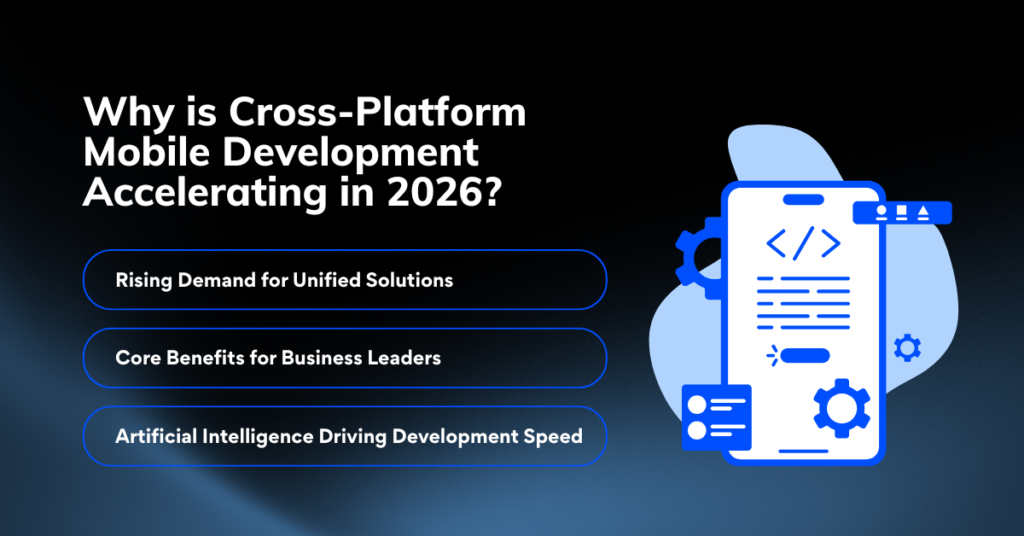
Rising Demand for Unified Solutions
Startups can’t afford to maintain separate teams for iOS, Android, and web development. This approach creates several challenges:
- Increased Costs: Managing separate codebases for each platform doubles infrastructure expenses.
- Siloed Collaboration: Isolated teams complicate cross-functional work and slow down progress.
- Version Fragmentation: Pushing updates separately leads to inconsistencies across devices.
Unified development ecosystems solve these problems by allowing a single engineering team to deploy feature updates across all platforms simultaneously.
Core Benefits for Business Leaders
Technical decision-makers evaluate frameworks based on their potential return on investment. By consolidating the codebase, companies can optimize their resources and accelerate growth.
- Streamlined Hiring: Instead of recruiting separate Swift (for iOS) and Kotlin (for Android) developers, you can hire engineers skilled in a single language like JavaScript or Dart.
- Reduced Costs: A simplified hiring process and smaller development team keep burn rates low.
- Faster Time-to-Market: Increased efficiency and streamlined workflows accelerate product launch timelines.
Artificial Intelligence Driving Development Speed
AI is fundamentally reshaping how developers write and maintain code. By 2026, AI-assisted development tools will be seamlessly integrated into cross-platform environments, allowing teams to:
- Automate boilerplate code: Leverage generative AI to handle repetitive coding tasks.
- Debug complex UI components: Quickly identify and resolve issues in the user interface.
- Generate testing scripts: Automate the creation of tests to ensure software quality.
This integration significantly reduces development effort, empowering small startup teams to produce enterprise-grade software.
Core Advantages of Cross-Platform App Development
Understanding the precise benefits of building a unified application helps technical leaders justify architecture decisions to stakeholders and investors.
Cost-Effectiveness and Budget Optimization
Developing separate native apps requires duplicate resources, doubling your engineering budget. A unified codebase cuts development costs by up to 50%.
For a startup with strict budget constraints, reallocating those saved funds toward marketing, customer acquisition, or infrastructure scaling provides a massive competitive advantage.
Rapid Deployment and Accelerated Time-to-Market
When your competitor is moving quickly, time-to-market is a critical success indicator. Cross-platform environments feature hot-reloading capabilities, allowing engineers to view code changes instantly without recompiling the entire app. This leads to faster product iterations, enabling founders to test minimum viable products (MVPs), gather user feedback, and pivot swiftly.
Code Reusability Across Multiple Ecosystems
Modern frameworks allow developers to share up to 90% of their code across iOS and Android. This code reusability drastically reduces technical debt. When a bug is identified or a new feature is requested, your team only needs to update a single file. This unified maintenance strategy ensures that technical debt remains manageable as your user base scales.
Consistent User Experience and Interface
Brand consistency builds user trust. When you build distinct native apps, slight variations in UI components can frustrate users switching between devices. Cross-platform tools use unified rendering engines to guarantee that buttons, animations, and transitions look identical, regardless of the underlying operating system.
Understanding the Limitations of Shared Codebases
While the benefits are substantial, making an informed decision requires understanding the trade-offs and potential risks associated with unified architectures.
No single technology solves every engineering problem flawlessly. Here are the key disadvantages to consider:
Potential Performance Bottlenecks
Applications that require heavy computational power such as high-end 3D gaming or complex augmented reality (AR) tools can experience slight performance degradation when routed through a cross-platform bridge.
If your core value proposition relies on pushing device hardware to its absolute limits, a pure native approach might still be necessary.
Complex Native Feature Integration
Cross-platform apps rely on plugins to access device-specific hardware like Bluetooth, advanced camera controls, or proprietary biometrics. If a plugin does not exist for a brand-new hardware feature released by Apple or Google, your engineering team will have to write custom native code to bridge the gap.
Reliance on Third-Party Framework Updates
When you build on a framework created by Google, Meta, or Microsoft, your product timeline is tethered to their update schedules.
When Apple releases a major iOS update, cross-platform frameworks usually experience a slight delay before they fully support the new operating system features.
Ecosystem Maturity and Tooling Limitations
While major frameworks are highly mature, niche libraries and community-driven packages can sometimes lack enterprise-level maintenance.
Startups must carefully audit third-party dependencies to ensure they do not introduce security vulnerabilities or unsupported code into the production environment.
When Cross-Platform May Not Be Ideal
Cross-platform development may not be the best choice when:
- Your application requires advanced device-specific features, deep hardware integration, or maximum use of native capabilities.
- Your app heavily dependent on high-performance graphics, complex animations, AR/VR experiences, or real-time processing
- You are building large-scale enterprise apps that require complex security, specialized workflows, or extensive system integrations.
- App performance is your top priority, and every millisecond matters, such as, in gaming, financial trading, or advanced media applications.
- Your app needs frequent access to the latest platform updates and features that are immediately available on native platforms
Top Cross Platform Mobile App Development Frameworks in 2026
Selecting the right technology stack depends heavily on your team’s existing skill sets and your application’s specific requirements.
Here is a breakdown of the leading ecosystems dominating the enterprise and startup markets.
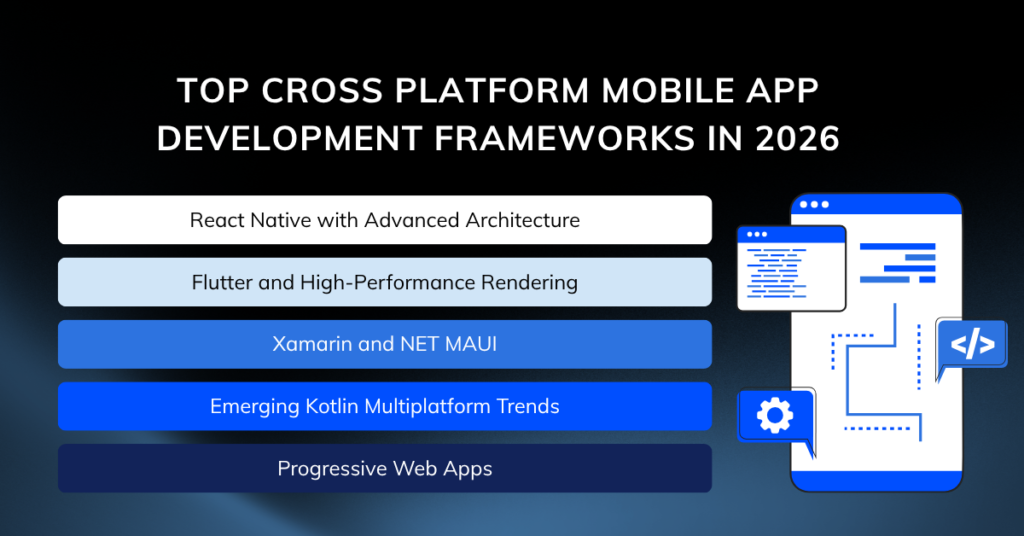
React Native with Advanced Architecture
Backed by Meta, React Native remains a dominant force. It allows teams to build mobile apps using JavaScript and React. The introduction of React Native’s New Architecture has eliminated legacy performance bottlenecks by facilitating direct communication between JavaScript and native threads.
Choose React Native if your startup already possesses a strong web development team skilled in JavaScript, as it allows for immediate cross-functional collaboration.
Flutter and High-Performance Rendering
Created by Google, Flutter uses the Dart programming language and a proprietary rendering engine (Impeller) to draw UI components directly onto the screen. This bypasses the need for native UI bridges, resulting in smooth, 120fps animations. According to Statista’s developer survey, Flutter is one of the most widely used cross-platform mobile frameworks, with 46% of surveyed developers reporting its usage.
Choose Flutter if your product requires complex, custom user interfaces and you want to guarantee absolute visual consistency across all operating systems.
Xamarin and NET MAUI
Microsoft officially deprecated Xamarin in 2024, replacing it entirely with .NET Multi-platform App UI (.NET MAUI). This modern framework allows developers to build native apps for Android, iOS, macOS, and Windows using a single C# codebase. It is highly optimized for enterprise environments.
Choose .NET MAUI if your company already relies heavily on the Microsoft ecosystem, Azure cloud services, and C# engineering talent.
Emerging Kotlin Multiplatform Trends
Kotlin Multiplatform (KMP) allows developers to share business logic across platforms while keeping the UI entirely native. According to industry reports from JetBrains, KMP is becoming the standard for AI-heavy applications requiring on-device inference and GPU acceleration without the overhead of a full UI abstraction layer.
Choose Kotlin Multiplatform if you refuse to compromise on native UI performance but still want to reduce the cost of writing duplicate backend logic.
Progressive Web Apps
Progressive Web Apps (PWAs) use standard web technologies (HTML, CSS, JavaScript) to deliver an app-like experience directly through a mobile browser. Users can install them on their home screens without visiting an app store.
PWAs bypass app store commissions and deployment delays, making them highly cost-effective for lightweight, content-driven platforms.
Cross Platform Mobile App Development Frameworks Comparison
| Framework | Best For | Learning Curve | Key Strength | Ideal Use Case |
| Flutter | UI-rich, high-performance apps | Medium (Dart) | Pixel-perfect UI, fast rendering | Design-heavy apps, consumer products |
| React Native | Fast MVPs & web-first teams | Low–Medium (JS/React) | Huge ecosystem, faster development | Startups, MVPs, rapid iteration |
| Kotlin Multiplatform | Enterprise-grade hybrid apps | Medium–High | Share logic, retain native UI | Large-scale apps needing flexibility |
| .NET MAUI | Microsoft ecosystem apps | Medium (C#/.NET) | Strong enterprise integration | Enterprise apps using Microsoft stack |
| Ionic (Hybrid) | Lightweight apps & quick builds | Low (Web tech) | Fastest development using HTML/CSS/JS | Internal tools, content-driven apps |
How to Choose the Right Framework for Your Project?
The decision-making process requires aligning your technology stack with your business objectives. Enlight Lab recommends evaluating frameworks against four specific criteria.
Evaluating Project Requirements and Budget Constraints
Analyze your product roadmap. If you are building a straightforward e-commerce application or a B2B SaaS dashboard, Flutter or React Native will deliver the best return on investment.
If budget constraints are exceptionally tight, prioritize the framework that allows you to ship a functional MVP the fastest.
Assessing Team Expertise and Hiring Efficiency
A technology stack is only as effective as the engineers wielding it. If your current team consists of seasoned React developers, forcing them to learn Dart for Flutter will slow down your product launch.
Leverage your existing talent pool to maximize early-stage efficiency.
Analyzing Performance Needs and Scalability
Evaluate how your application consumes data. Products that process massive amounts of real-time data or rely on complex background processing must prioritize frameworks with excellent memory management.
Kotlin Multiplatform excels in high-performance scenarios where business logic complexity is high.
Reviewing Community Support and Ecosystem Longevity
Never adopt a framework with a shrinking community. Robust open-source communities provide access to pre-built plugins, extensive documentation, and rapid bug fixes. React Native and Flutter boast the largest, most active communities in 2026, ensuring that your startup will not be left with obsolete technology.
Cost Implications
Factor in total cost of ownership. While the frameworks themselves are open-source and free, costs accumulate through specialized hiring, third-party premium plugins, and ongoing maintenance.
Ensure the chosen path aligns tightly with your startup’s budget constraints and funding runway.
Best Practices for Cross Platform Deployments
Executing a successful launch requires strict adherence to engineering standards. Follow these protocols to ensure stability and user satisfaction.
Thorough Planning and Design
Never rush the architecture phase.
- Map out your data models, state management solutions, and API integrations before writing a single line of code.
- Establish clear coding guidelines to ensure seamless collaboration between front-end and back-end teams.
Performance Optimization Focus
Optimize your assets.
- Compress images, minimize the use of heavy animations, and implement lazy loading for long lists of data.
- Efficient memory management prevents the application from draining battery life or crashing on older smartphone models.
Rigorous Testing Protocols
A bug on a shared codebase often manifests differently across operating systems.
- Implement automated testing pipelines, including unit tests, integration tests, and end-to-end UI testing.
- Utilize device farms to test your application across thousands of real physical devices, accounting for different screen sizes and OS versions.
Mobile First Design Philosophy
Design your user experience specifically for mobile interaction.
- Touch targets must be appropriately sized, navigation must be intuitive, and the application must gracefully handle poor network connectivity.
- Do not simply shrink a desktop web application to fit a mobile screen.
Framework Updates and Maintenance
Allocate dedicated engineering hours specifically for technical maintenance.
- Regularly update your core framework and third-party dependencies to patch security vulnerabilities and maintain compliance with App Store guidelines.
- Ignoring technical debt guarantees future system failures.
How Can AI Optimization Improve Cross-Platform Content Visibility?
For applications relying on organic user acquisition, technical infrastructure must align seamlessly with search visibility. Modern cross-platform apps increasingly integrate Generative Engine Optimization (GEO) and Answer Engine Optimization (AEO) to capture traffic from AI-driven search tools.
Implementing Structured Data and Schema Markup
Search engines use schema markup to understand the context of your application data. By embedding structured data into your app’s web presence and deep links, you enable AI systems to index your content accurately. This ensures your software appears prominently in AI Overviews when users search for solutions your app provides.
Utilizing Natural Language Processing for Relevance
AI-driven search engines prioritize context over keyword density. Ensure the content embedded within your application and its landing pages uses natural, fact-dense language. Clearly state the exact problems your application solves, using specific entities and verifiable statistics to build algorithmic trust.
Enhancing Voice Search Optimization for Mobile
As voice-activated assistants become ubiquitous, optimizing for voice search is non-negotiable. Voice queries are conversational and typically longer than text searches. Structure your app’s public-facing content to directly answer “who, what, where, when, and how” questions to capture this growing demographic.
Adapting to Future AI and SEO Trends
The algorithms powering AI search engines evolve rapidly. Startups must build their digital presence using clean architecture and rapid load times. Cross-platform frameworks that support efficient server-side rendering for companion web applications will outrank sluggish, poorly optimized competitors.
Navigating the Future of Cross-Platform Mobile App Development
Building a startup is a race against time, competitors, and capital. Cross-Platform Mobile Development in 2026 provides the agility, cost-effectiveness, and scalability required to win that race.
By leveraging frameworks like Flutter, React Native, .NET MAUI, or Kotlin Multiplatform, technical decision-makers can efficiently manage technical debt while delivering exceptional user experiences.
The key to success lies in matching your chosen framework to your specific business constraints and team expertise.
At Enlight Lab, we specialize in helping startups navigate these complex technical decisions, providing the scalable solutions and engineering infrastructure needed to turn your vision into reality.
Connect with us today to build a high-performance cross-platform app and empower your growth journey without disruption.