How Can Digital Transformation Help You Scale Business Operations? 

What is Digital Transformation and how does it help scale business operations?
Digital Transformation is the process of integrating digital technologies such as AI, automation, cloud, and data analytics into every part of your business to streamline workflows and deliver value to customers. For scaling businesses, it means replacing slow manual processes with smart, automated systems.

Digital transformation helps scale business operations by:
Automating repetitive workflows
Improving real-time decision-making with data
Enhancing operational efficiency
Integrating systems for seamless processes
Enabling faster business growth

Your business is growing faster than your systems can handle. Orders pile up. Your team copies data between five tools by hand. A customer asks a simple question, and three people scramble to find the answer. Growth should feel like progress. Instead, it feels like things are getting harder to manage.  

That’s where digital transformation helps businesses scale more effectively. It replaces time-consuming manual work with scalable systems that support growth without adding complexity. Done right, it lets you scale revenue without scaling headcount at the same rate.  

This guide breaks down what that actually means for an early-stage company. You’ll learn where scaling really breaks, which operations to fix first, what it costs, and how to avoid the mistakes that drain budgets.  

What Digital Transformation Really Means for a Growing Business 

Digital Transformation is the work of replacing manual processes with connected software systems, so your business runs faster, cheaper, and with fewer errors as it grows. 

It is neither a buying-one tool nor a new website. It is changing how work flows through your company so that growth doesn’t crush your team. 

The Three Layers That Matter 

When you scale operations, transformation touches three things: 

  • Process — How work moves from start to finish 
  • Data — One source of truth 
  • Automation — Repetitive tasks handed to software 

Get all three working together and operations stop being the bottleneck. They become the engine. 

Importance of Digital Transformation for Scaling Operations 

Manual work doesn’t scale. It breaks.  

When you had 20 customers, a spreadsheet was fine. At 200, that same spreadsheet is a liability. It creates a ceiling on your growth. 

Digital transformation removes that ceiling. It allows you to handle more volume without a matching jump in cost or chaos. That’s the whole point. 

Here’s why it is essential for every growing company: 

  • It Breaks the link between revenue and costs.  
  • You can double your customer base without having to double your team. 
  • Companies with higher digital maturity are 23% more profitable than their less mature peers, according to Deloitte research. 
  • The companies that automate early gain a competitive advantage 

McKinsey research shows that organisations with strong digital and AI maturity consistently outperform their peers, achieving higher revenue growth and improved financial performance.

The Core Pillars of Digital Transformation in Business Operations

The most successful organizations don’t transform randomly. They anchor their strategy in a few foundational pillars that ensure efficiency, agility, and long-term scalability. 

Below are the key pillars that power scalable business operations through digital transformation: 

Process Automation 

One of the biggest benefits of digital transformation is automation. It is a fundamental pillar because it improves productivity and reduces operational risk. 

  • Automates routine operations like approvals, reporting, and data entry 
  • Reduces human error and operational delays 
  • Frees teams to focus on high-value work 

Data-Driven Decision Making  

Scaling operations without data is like moving fast without direction. Digital transformation enables businesses to leverage data as a strategic asset. Organizations that treat data as a core capability can get: 

  • Real-time insights into operations and performance 
  • Predictive analytics for better decision-making 
  • Unified data across departments 

Cloud Infrastructure 

Traditional infrastructure limits scalability. Cloud technologies enable: 

  • On-demand scaling of systems and operations 
  • Faster deployment of applications and updates 
  • Reduced dependency on legacy hardware 

System Integration & APIs  

Many businesses struggle because systems don’t “talk” to each other. Without integration, scaling creates complexity instead of efficiency. Integrations help organizations: 

  • Connect ERP, CRM, SaaS platforms, and internal systems into a unified ecosystem  
  • Eliminate data silos and reduce manual handoffs  
  • Enable real-time visibility and cross-functional collaboration 

Customer-Centric Operations Design  

Businesses that design operations around customer experience gain: 

  • Personalized and seamless customer journeys 
  • Faster response times and improved service delivery 
  • Omnichannel engagement 

Culture & Change Management 

Technology alone does not transform a business. Many digital transformation initiatives fail because employees do not adopt new tools, processes, or ways of working. 

A strong culture of change: 

  • Encourages adoption of digital tools and workflows  
  • Aligns leadership and teams around transformation goals  
  • Promotes agility, adaptability, and continuous improvement  
  • Helps employees embrace change with confidence 

How Digital Transformation Helps You Scale Operations 
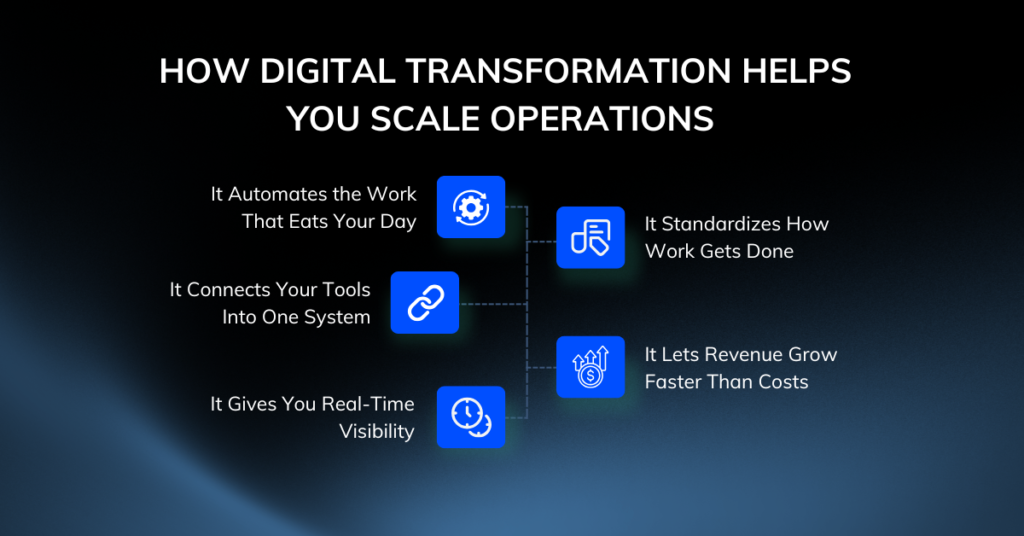
Scaling means handling more volume without a matching jump in cost or chaos. Transformation makes that possible in five concrete ways. 

1. It Automates the Work That Eats Your Day 

Repetitive tasks are everywhere. Invoicing. Data entry. Status updates. Follow-up emails. Each one is small. Together, they swallow entire workweeks. 

Automate them and you reclaim that time. A workflow tool can take a new order, generate the invoice, update inventory, and notify the customer all without a person touching it. Deloitte has reported that automation can cut process costs by up to 30%. That’s margin you keep. 

2. It Connects Your Tools Into One System 

Right now your data is scattered. Sales lives in one app, finance in another, support in a third. Nobody trusts the numbers because nobody agrees on them. 

Integration fixes this. When your tools talk to each other, a sale recorded in your CRM updates your accounting and your inventory automatically. One source of truth. No reconciliation marathons. 

3. It Gives You Real-Time Visibility 

You can’t fix what you can’t see. Connected systems feed live dashboards that show you cash flow, customer activity, and operational health at a glance. 

That turns guesswork into decisions. You spot a problem on Tuesday instead of discovering it in next month’s close. 

4. It Standardizes How Work Gets Done 

When processes live in people’s heads, you’re fragile. One resignation and the knowledge walks out the door. 

Documented, software-enforced workflows make your operation repeatable. New hires get productive in days, not months. Quality stays consistent no matter who’s on shift. 

5. It Lets Revenue Grow Faster Than Costs 

This is the whole point. Manual operations grow costs in lockstep with revenue. Automated operations break that link. 

When software handles the volume, doubling your customers doesn’t mean doubling your team. That’s the difference between a business that scales and one that just gets busier. 

This is the heart of digital transformation for business growth. It is not technology for its own sake, but systems that let you sell more without spending proportionally more to deliver. 

AI and Its Role in Modern Digital Transformation Strategies  

The role of AI in digital transformation goes far beyond automation. AI is becoming a core driver of modern digital transformation, helping businesses improve efficiency, make better decisions, and scale operations more effectively. For a growing company, AI delivers three outcomes: 

  • Automate manual work. It absorbs the repetitive tasks that burn hours and stall your team. 
  • Predict future needs. It analyzes data to show you what’s coming next, so you can stop reacting and start preparing. 
  • Eliminate human error. It cuts the mistakes that happen during manual handoffs between systems and teams. 

Which Operations Should You Transform First? 

You can’t fix everything at once. Trying to will drain your budget and exhaust your team. 

Start where the pain is sharpest and the payoff is fastest. 

The Highest-Impact Areas to Automate 

  • Finance and billing — Automate invoicing, payments, and reconciliation to stop revenue leakage and late nights. 
  • Customer onboarding — Standardize setup so new clients start fast and your team isn’t the bottleneck. 
  • Sales and CRM — Track every lead automatically so deals stop falling through the cracks. 
  • Support and ticketing — Route and resolve common requests with automation so response times shrink. 
  • Inventory and fulfillment — Sync stock levels across channels to prevent overselling and stockouts. 

How to Pick Your Starting Point 

Run each candidate through three quick questions: 

  1. How much time does this process waste each week?  
  1. How often do errors here cost real money?  
  1. Will this block growth in the next six months?  

Pick the process that scores highest on all three. Start there. Win. Then move to the next.

Where to start digital transformation:
Begin with the process that wastes the most time, produces the most costly errors, and threatens to block growth soonest. For most early-stage companies, that’s finance, onboarding, or customer support.

Building a Digital Transformation Strategy That Actually Works 

A pile of tools is not a plan. Buying software without a clear sequence is how startups end up with eight subscriptions and no real progress. 

A real digital transformation strategy is a roadmap. It tells you what to fix, in what order, and how you’ll measure the win. 

Assess Your Current Infrastructure and Identify Gaps 

Your first step is to audit your existing workflows. You cannot fix a process you do not understand. A proper audit identifies every bottleneck, manual task, and source of error that slows you down. 

Start by mapping your current state: 

  • Trace the workflow: Document every step of your critical operations, from lead capture to customer onboarding. 
  • Pinpoint the bottlenecks: Find exactly where works slow down, handoffs fail, and errors occur.  
  • Quantify the waste: Measure the time your team loses to repetitive data entry, administrative tasks, and fixing preventable errors. 

Develop a Phased Implementation Roadmap 

Don’t try to fix everything at once. A phased approach delivers value faster and builds momentum for larger change. 

Start with the highest-impact, lowest-effort wins. 

  • Prioritize by Pain: Target the single process that wastes the most time or directly threatens your growth. For most startups, this is finance, hiring, or customer support. 
  • Secure an Early Win: Focus all your energy on automating that one area successfully. A concrete victory makes the case for further investment. 
  • Roll Out Sequentially: Use the momentum and learnings from your first win to tackle the next-most critical problem. 

Foster a Culture of Digital Adoption 

Your team has to use the tools you build. If you don’t get their input, they will fall back on old, inefficient methods. Adoption isn’t a launch event. It’s a habit you build by making the new way easier than the old one. 

  • Get early buy-in. Involve your team from day one. Their feedback is not a suggestion—it’s a requirement for success. 
  • Demonstrate clear value. The new process must be simpler and faster than the old one. If it isn’t, it won’t be used. 
  • Train for proficiency. Don’t just show them the tool. Show them how it solves their biggest frustrations and makes their work easier. 

Set Metrics Before You Build 

You can’t claim a win you can’t measure. Decide upfront what success looks like: 

  • Time saved per week on the targeted process 
  • Error rate before and after automation 
  • Cost per transaction or per customer served 
  • Speed to onboard a new customer or employee 

Track these from day one. Numbers turn a “nice idea” into a defensible business decision your investors will respect. 

The Mistakes That Drain Transformation Budgets 

Most failed transformations don’t fail because of bad technology. They fail because of bad decisions. 

Avoid these and you’re ahead of most. 

Mistake 1: Buying Tools Before Mapping Processes 

Software doesn’t fix a broken process. It speeds it up. Automate a mess and you get a faster mess. Map first, then buy. 

Mistake 2: Trying to Change Everything at Once 

Big-bang transformations overwhelm teams and budgets. They stall halfway and get abandoned. Small, sequenced wins compound. Start narrow. 

Mistake 3: Ignoring the People Using the System 

Your team has to actually use what you build. Skip their input and they’ll route around it with the old spreadsheets. Bring them in early. 

Mistake 4: Building Technical Debt You’ll Pay For Later 

Moving too fast without proper architecture always leads to crippling technical debt down the road. Quick hacks save days now and cost months later. Build it right the first time. 

Mistake 5: Skipping the Metrics 

If you don’t measure, you can’t tell what worked. You’ll repeat mistakes and can’t defend the spend. Set metrics before you start. 

Real Signs You’re Ready to Transform 

Timing matters. Push too early and you over-engineer. Wait too long and growth chokes. 

You’re ready when these things are true. 

Watch for these triggers 

  • You just closed funding. New capital is the moment to build the systems that handle the growth investors expect. 
  • A competitor is moving faster. If they ship and respond quicker, their operations are likely more automated than yours. 
  • Customer demand is spiking. When volume strains your current setup, it’s time to build for the next level. 
  • Your team is burning out on busywork. When good people quit over repetitive grind, your operations are the problem. 
  • Your tech stack is aging. Outdated tools that don’t integrate are quietly capping how fast you can grow. 

Recognize two or more of these? You already have what you need to begin. 

How Enlight Lab Helps You Scale Without the Chaos 

Most agencies sell you software. We build you systems. 

Enlight Lab works with founders and tech leaders who need their operations to keep pace with their ambition. We don’t drop a tool on your desk and walk away. We map your processes, find what’s actually slowing you down, and build the connected systems that let you grow without adding chaos. 

What Working with Us Looks Like 

  • We learn how you actually operate before we recommend a single tool. 
  • We build for your stack and budget that fit what you have and what you can spend, with no lock-in surprises. 
  • We architect and clean systems built to handle tomorrow’s volume. 
  • We prove the return. Every project ships with metrics that show what you saved and what you gained. 

You get an operation that scales as fast as you do. Your team gets their time back. Your investors get the efficiency they’re paying for. 

Stop Paying the Manual Tax. Scale Smarter with Digital Transformation

The businesses that struggle with scale didn’t fail to grow. They failed to build the foundation that makes growth sustainable. 

Digital Transformation is that foundation. Not a silver bullet. Not a one-time project. Not the newest software tool. It’s the disciplined, strategic work of building a business that runs on clear data, connected systems, automated processes, and a team that’s empowered. 

The question isn’t whether digital transformation matters for your business. It does. The question is either of these two: 

  • Whether you’ll build this capability while you still have the space to do it thoughtfully 
  • Whether you’ll be forced to rebuild it mid-crisis, under pressure, at a fraction of the quality. 

If you’re a startup founder, CTO, or decision-maker who’s been putting this off, this is your signal. You don’t have to fix everything today. You just have to start with the one process costing you the most. 

Enlight Lab is here to help you build the digital foundation your business deserves not with generic advice, but with a clear-eyed, personalized strategy. Book a free strategy call with us today. We’ll map your biggest bottleneck and show you exactly what to fix first. No obligation, just a clear plan.

Frequently Asked Question (FAQ)

Digital transformation in business operations is the integration of digital technologies into workflows, systems, and processes to improve efficiency and scalability. It fundamentally changes how businesses operate, deliver value, and make decisions.

Digital transformation improves scalability by enabling automation, cloud-based infrastructure, and integrated systems that grow with your business. It allows operations to expand without increasing complexity or costs proportionally.

Digital transformation enhances operational efficiency, improves customer experience, and enables faster, data-driven decision-making. It also drives innovation, reduces costs, and supports long-term business growth.

Digital transformation uses technologies like AI, cloud computing, data analytics, automation (RPA), and IoT to optimize operations. These tools help businesses become more agile, efficient, and data-driven.

Start digital transformation by defining clear business goals, assessing current processes, and creating a structured roadmap for implementation. Focus on high-impact areas, adopt the right technologies, and continuously optimize based on results.

Partner with Experts

Leave Your Comment

Blogs

Related Stories