Years ago, managing massive datasets required building sprawling physical environments. Technology leaders invested heavily in on-premise servers to process information. That approach worked well for early big data initiatives. Now, those same legacy systems are holding organizations back.
Running an on-premise data environment requires constant hardware upgrades, specialized maintenance teams, and strict physical security. When a business needs more storage, it must buy more computing power, even if that extra processing power sits idle. A Hadoop to Databricks migration solves these structural inefficiencies. Moving to a cloud-native lakehouse platform allows technology leaders to separate storage from compute, meaning you only pay for exactly what you use.
This guide breaks down exactly why your legacy systems are costing you more than you realize, and it provides a clear, actionable roadmap for transitioning your enterprise to a modern data intelligence platform.
What Drives the Need for A Data Platform Transition?
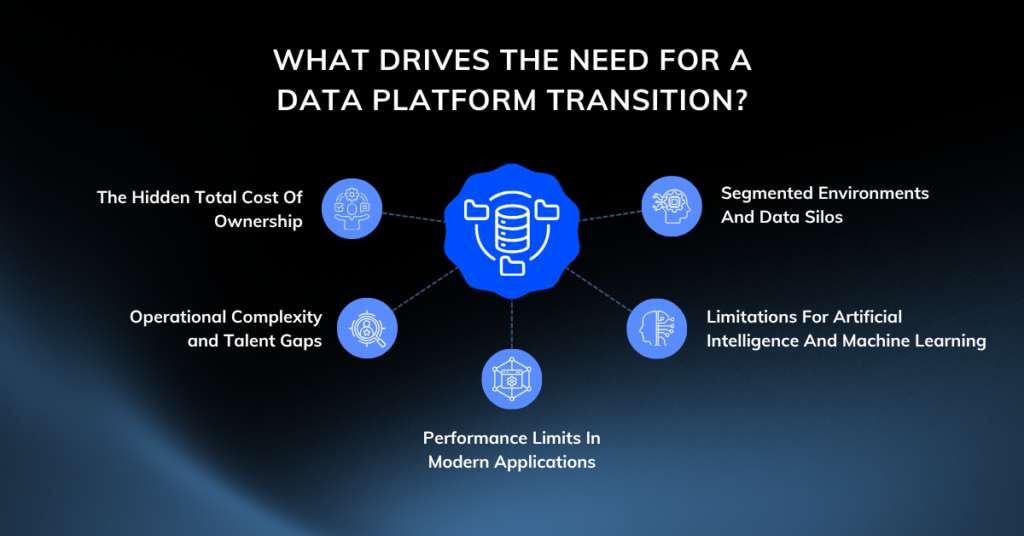
Understanding the hidden burdens of legacy infrastructure is the first step toward modernization. Many business owners focus strictly on software licenses when evaluating their budgets. They miss the massive operational costs dragging down their bottom line.
The Hidden Total Cost Of Ownership
Evaluating the true cost of an on-premise system requires looking past the initial software price tag. According to Databricks, data center management accounts for nearly 50% of the total cost of ownership for Hadoop environments. Meanwhile, actual software licensing makes up less than 15% of the total cost. Powering and cooling a physical data center represents a massive financial drain.
A standard 100-node cluster can generate up to $80,000 per year in electricity and cooling costs alone. Furthermore, purchasing replacement hardware accounts for roughly 20% of your total infrastructure budget.
Operational Complexity and Talent Gaps
Maintaining physical servers demands a highly specialized, dedicated workforce. Organizations typically require 4 to 8 full-time engineers for every 100 nodes just to keep the infrastructure running smoothly. This heavy DevOps burden forces talented data engineers to spend their days troubleshooting server errors instead of building features that generate revenue.
Performance Limits In Modern Applications
Legacy big data platforms couple storage and compute tightly together. If your business accumulates a massive amount of historical data, you must buy expensive new server nodes to hold it. You are forced to pay for additional processing power that you do not actually need. This rigid architecture slows down query speeds and makes scaling incredibly expensive.
Segmented Environments And Data Silos
When different departments run their own localized clusters, collaboration stops. Marketing teams cannot easily cross-reference their metrics with supply chain data. This fragmentation prevents executives from gaining a clear, unified view of company performance.
Limitations For Artificial Intelligence And Machine Learning
Modern artificial intelligence requires rapid access to massive, unified datasets. Legacy systems struggle to process real-time streams and handle the complex algorithms required for machine learning. Enterprises attempting to run predictive analytics on aging physical servers often face failed jobs, timed-out queries, and frustrated data scientists.
How Does Databricks Modernize Your Data Architecture?
The Databricks lakehouse platform combines the reliability of a traditional data warehouse with the flexibility of a data lake. This unified approach eliminates the friction that plagues older technologies.
Unified Analytics Through The Lakehouse Architecture
Databricks centralizes all your data, analytics, and artificial intelligence workloads into one cohesive environment. You no longer need to move data between separate storage lakes and analytical warehouses. Your data engineers, analysts, and business leaders all operate from the exact same source of truth.
Independent Scaling for Speed and Efficiency
Cloud-native architecture separates your storage capacity from your processing power. You store your data in affordable cloud environments like AWS S3 or Azure Data Lake Storage. When you need to run an intensive analytical query, Databricks spins up a highly optimized computing cluster, processes the job rapidly using its Photon engine, and automatically shuts the cluster down when the task finishes. You never pay for idle servers.
Reduced Complexity For Developer Productivity
Databricks abstracts away the painful infrastructure management that bogs down technical teams. Developers do not manually configure clusters or install complex dependencies. They simply open a collaborative workspace, select their preferred programming language, and start writing code.
Collaborative Workspaces for Data Teams
The platform provides shared, interactive notebooks that support Python, SQL, Scala, and R. A data engineer can build a pipeline in Python, and a business analyst can query that exact same pipeline using SQL within the same collaborative environment.
Built-in Capabilities For Advanced Data Science
Databricks natively supports the complete machine learning lifecycle. Data scientists use built-in tools like MLflow to track experiments, package code, and deploy predictive models directly into production. The platform easily handles everything from basic regression models to complex generative AI applications.
Clear Advantages for Cost Optimization
Choose Databricks if reducing operational overhead is your primary concern. By eliminating physical hardware replacements, reducing data center power consumption, and automating cluster management, enterprises frequently see massive improvements in their return on investment.
What Makes Moving to A Cloud Platform A Strategic Necessity?
Transitioning your data infrastructure is a fundamental business decision. Companies that hesitate to modernize their data pipelines risk losing their competitive standing.
Competitive Advantages from Real-time Insights
Consumer expectations shift rapidly. If your competitor can analyze purchasing trends in real time while your team waits hours for a batch job to finish, you lose market share. A modern lakehouse platform processes streaming data instantly, allowing your leadership team to make agile, informed decisions.
Revenue Growth Through Advanced Analytics
Clean, accessible data powers personalization and predictive modeling. Retailers use modern platforms to forecast seasonal demand with high accuracy. Financial institutions detect fraudulent transactions the moment they occur. These advanced capabilities directly protect and expand your revenue streams.
Talent Acquisition For Modern Data Engineering
A top-tier software development company offers qualitative data engineering services to help you work with cutting-edge tools. They do not want to maintain obsolete on-premise hardware. Upgrading your technology stack makes your company highly attractive to the best technical talent in the industry.
Long-Term Viability Of Your Data Infrastructure
Cloud platforms evolve continuously. When Databricks releases a performance upgrade or a new AI capability, your enterprise gains immediate access to it. Your infrastructure naturally keeps pace with global technological advancements without requiring massive internal upgrade projects.
What Are the Essential Phases of A Successful Migration?
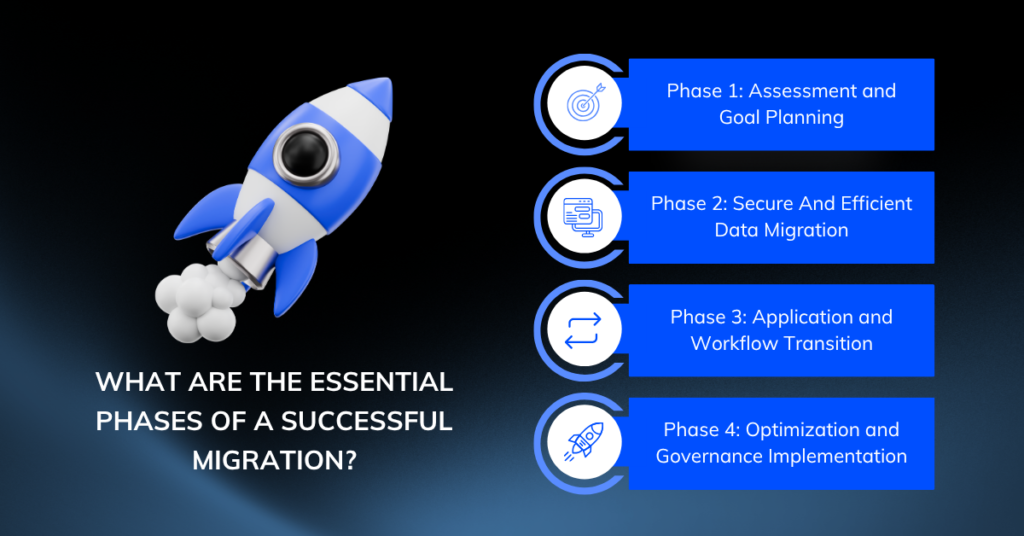
A massive infrastructure transition requires rigorous planning. Following a structured roadmap protects your business continuity and ensures a smooth deployment.
Phase 1: Assessment and Goal Planning
Start by defining exactly what you want to achieve. Do you want to cut costs by 30%? Do you need to run analytical queries twice as fast? Document these key performance indicators immediately.
- Take inventory: Audit your existing workloads, datasets, and security protocols.
- Choose a strategy: Choose a lift-and-shift approach if immediate data center exit deadlines dictate your timeline. Choose a complete refactoring strategy if maximizing long-term cloud performance matters more than initial migration speed.
- Build your team: Assemble a cross-functional group of data owners, security officers, and platform administrators.
Phase 2: Secure And Efficient Data Migration
Your data is your most valuable asset. Moving it requires precision. Establish a dual ingestion strategy where new data flows into both your legacy system and your new cloud storage simultaneously. This creates a safe testing environment.
- Use native cloud transfer services like AWS Snowball or Azure Data Box for massive historical datasets.
- Set up automated pipelines using Apache Spark to pull incremental updates securely into the cloud.
- Ensure all data governance and encryption protocols remain active during the transfer.
Phase 3: Application and Workflow Transition
Once your data lives securely in the cloud, you must point your operational logic toward the new environment.
- Convert existing MapReduce or Hive queries to optimized Spark SQL.
- Migrate your orchestration tools. Replace legacy schedulers with modern cloud equivalents like Databricks Workflows or Apache Airflow.
- Reconnect your business intelligence dashboards. Point Tableau or PowerBI directly to Databricks using optimized JDBC connectors to restore executive reporting capabilities.
Phase 4: Optimization and Governance Implementation
A successful migration does not end when the data moves. You must fine-tune the new system to maximize your investment.
- Implement Unity Catalog to establish centralized, attribute-based access controls across your entire organization.
- Configure auto-termination policies on your computing clusters to guarantee you never pay for unused processing power.
- Set up automated data quality monitoring to build trust with your business analysts.
Which Common Migration Pitfalls Should Your Team Avoid?
Many organizations stumble during digital transformations because they fail to anticipate predictable challenges.
Underestimating The Transition Complexity
Data migration involves more than copying files from one hard drive to another. It requires translating complex query logic, updating hard-coded environmental variables, and re-architecting data schemas. Rushing this process guarantees broken pipelines and frustrated users.
Proceeding Without Clear Business Objectives
If you migrate without defining specific business goals, you cannot measure success. Always tie your technical transition to concrete outcomes, like accelerating monthly financial reporting or deploying a specific predictive AI model.
Treating Data Governance as An Afterthought
Never move sensitive data into a new environment without establishing your security framework first. Define your access control lists and data masking rules before you begin the primary data transfer.
Overlooking Team Training Requirements
Your data engineers need time to adapt to a new platform. Provide comprehensive training on cloud architecture and Databricks best practices early in the migration process.
Bypassing Critical Security Protocols
Ensure your identity providers, such as Azure Active Directory or Google Workspace, integrate flawlessly with your new platform via Single Sign-On. Misconfigured authentication protocols create massive security vulnerabilities.
How Does Enlight Lab Ensure a Seamless Transition?
Navigating a massive infrastructure overhaul requires specialized expertise. Enlight Lab provides the technical leadership necessary to modernize your enterprise safely and efficiently.
Proven Methodology For Complex Data Migrations
Enlight Lab utilizes a structured, phased approach to platform modernization. We conduct deep architectural audits, establish dual-ingestion safety nets, and meticulously translate legacy code into optimized Spark workflows. Our data engineering services eliminate the guesswork from your transition.
Real-world Success Stories
We partner with organizations across highly regulated industries, including finance and healthcare, to securely modernize their data ecosystems. Our engineers consistently deliver projects that reduce infrastructure costs, accelerate query speeds, and establish unshakeable data governance.
Value-Driven Delivery And Ongoing Support
Enlight Lab integrates deeply with your internal teams. Through our staff augmentation services, we provide senior engineers who fill critical skill gaps during the transition. We focus entirely on delivering tangible business value, ensuring your new platform drives immediate operational efficiency.
Why Your Hadoop to Databricks Migration Is an Investment In The Future
Clinging to obsolete data center hardware prevents your business from evolving. A comprehensive Hadoop to Databricks migration strips away the friction of legacy infrastructure, replacing it with an agile, infinitely scalable platform.
By embracing this transition, technology leaders empower their teams to leverage advanced artificial intelligence, uncover hidden revenue streams, and secure a dominant position in an increasingly data-driven market.
Connect with Enlight Lab today to map out your secure path to the cloud.