Most executives asking how much it costs to build an AI chatbot expect a single number. In reality, enterprise chatbot pricing ranges from 8,000 dollars for a basic scripted assistant to well over 500,000 dollars for a multi-agent, retrieval-augmented system integrated across a global tech stack. The right question isn’t “what does a chatbot cost?” It’s “what does a chatbot that solves my specific problem, at my scale, with my compliance requirements, actually cost to build and run?”
This guide answers that question directly. It’s written from the perspective of a team that has scoped, built, and maintained production chatbots for regulated and high-growth enterprises. No vague ranges, no “it depends” without substance. Just the cost frameworks, architecture trade-offs, and decision tools that CTOs, CIOs, and product leaders need before they request a proposal.
Executive Summary
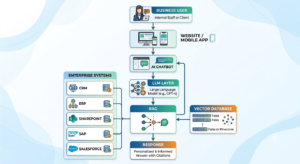
Building an AI chatbot in 2026 costs anywhere from 8,000 dollars to 500,000+ dollars, depending on architecture complexity, data integration needs, and compliance scope. A simple FAQ bot on a no-code platform sits at the low end. A custom retrieval-augmented generation (RAG) system with enterprise system integrations, security hardening, and multi-language support sits at the high end. Ongoing maintenance typically runs 15 to 25 percent of the initial build cost per year.
The biggest driver of cost isn’t the chatbot itself. It’s the data layer underneath it: how many systems it needs to connect to, how clean that data is, and how much retrieval infrastructure is required to make responses accurate. Organizations that treat chatbot development as a UI project instead of a data engineering project consistently underestimate their budgets by 40 to 60 percent.
Quick Pricing Answer: AI Chatbot Cost at a Glance
| Chatbot Type | Typical Cost Range | Timeline | Best For |
|---|---|---|---|
| No-code / template bot | 8,000 to 25,000 dollars | 2 to 4 weeks | Basic FAQ, lead capture |
| Custom rule-based chatbot | 20,000 to 50,000 dollars | 4 to 8 weeks | Structured workflows, simple support |
| Generative AI chatbot (LLM-powered) | 40,000 to 120,000 dollars | 8 to 14 weeks | Customer support, internal tools |
| RAG-based enterprise chatbot | 80,000 to 250,000 dollars | 12 to 20 weeks | Knowledge-heavy, document-grounded answers |
| Multi-agent enterprise platform | 200,000 to 500,000+ dollars | 20 to 40+ weeks | Complex workflows, multiple systems, high compliance |
These figures reflect fully loaded development costs, including discovery, engineering, integration, and initial testing. They exclude ongoing model inference costs and long-term maintenance, which we break down later in this guide.
AI Chatbot Pricing by Business Type
Different business models need fundamentally different chatbot architectures, which changes the cost structure significantly.
| Business Type | Primary Use Case | Typical Investment | Key Cost Driver |
|---|---|---|---|
| SaaS / B2B Tech | In-app support, onboarding | 40,000 to 100,000 dollars | Product documentation integration |
| E-commerce / Retail | Product discovery, order support | 30,000 to 90,000 dollars | Catalog sync, inventory APIs |
| Healthcare | Patient triage, appointment support | 100,000 to 300,000 dollars | HIPAA compliance, clinical accuracy |
| Financial Services | Account queries, advisory support | 120,000 to 350,000 dollars | Regulatory compliance, audit trails |
| Insurance | Claims support, policy Q&A | 90,000 to 250,000 dollars | Legacy system integration |
| Manufacturing | Internal knowledge, supply chain queries | 60,000 to 180,000 dollars | ERP and SCADA integration |
| Travel and Hospitality | Booking assistance, itinerary support | 40,000 to 120,000 dollars | Real-time inventory, multi-language |
| Education | Student support, admissions Q&A | 30,000 to 90,000 dollars | LMS integration, seasonal traffic spikes |
Regulated industries consistently sit at the higher end not because the AI itself is more expensive, but because compliance validation, audit logging, and access control add substantial engineering overhead.
Cost Breakdown by Development Phase
Enterprise chatbot projects follow a fairly consistent phase structure.
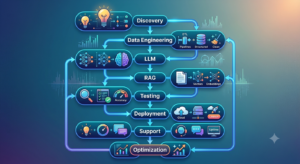
Here’s how budget is typically allocated across a mid-to-large deployment.
| Phase | What It Includes | Share of Budget |
|---|---|---|
| Discovery and scoping | Requirements, use case mapping, architecture design | 8 to 12 percent |
| Data engineering | Data collection, cleaning, pipeline building, indexing | 20 to 30 percent |
| Core AI development | LLM integration, prompt engineering, RAG pipeline, fine-tuning if needed | 25 to 35 percent |
| System integrations | CRM, ERP, ticketing, authentication, third-party APIs | 15 to 20 percent |
| Security and compliance | Access controls, encryption, audit logging, penetration testing | 8 to 15 percent |
| Testing and QA | Accuracy testing, adversarial testing, load testing | 8 to 10 percent |
| Deployment and training | Production rollout, staff training, documentation | 5 to 8 percent |
Based on our implementation experience, data engineering is the phase organizations most consistently under budget. Teams plan for prompt engineering and model selection, then discover mid-project that their source documents are unstructured, duplicated, or scattered across five different systems with no consistent format.
What Affects AI Chatbot Pricing
Six factors determine where a project lands within these ranges.
- Architecture complexity. A rule-based flow costs a fraction of a RAG or agentic system because there’s no retrieval layer, no vector database, and far less prompt engineering.
- Number of data sources. Every additional system a chatbot needs to query, whether a CRM, a document repository, or a legacy database, adds integration and maintenance cost.
- Accuracy requirements. Healthcare and finance need extensive grounding, citation, and hallucination-mitigation work that a marketing FAQ bot doesn’t.
- Compliance scope. HIPAA, SOC 2, GDPR, and PCI DSS each add specific engineering and audit requirements.
- Channel coverage. Web, mobile, WhatsApp, Slack, Teams, and voice each require separate integration work.
- Language and localization. Multi-language support multiplies testing effort and can affect model and infrastructure choice.
Organizations often underestimate how much accuracy requirements alone shift the budget. A chatbot that can be “mostly right” costs half of one that must be “verifiably right with citations,” because the second requires structured retrieval, response validation, and often human-in-the-loop review workflows.
Build vs Buy: What Actually Makes Sense
| Factor | Buy (SaaS Platform) | Build (Custom) |
|---|---|---|
| Upfront cost | Lower, 5,000 to 30,000 dollars/year | Higher, 40,000 to 500,000+ dollars |
| Time to launch | Days to weeks | Months |
| Customization | Limited to platform capabilities | Full control over architecture |
| Data ownership | Often shared with vendor | Fully owned |
| Long-term cost at scale | Can exceed custom build due to per-seat or per-conversation pricing | Predictable, scales with infrastructure |
| Compliance control | Dependent on vendor certifications | Built to your exact requirements |
| Competitive differentiation | Minimal, same tools as competitors | High, tailored to your data and workflows |
Buying makes sense for standard use cases with limited data complexity and fast time-to-market needs. Building makes sense when the chatbot touches proprietary data, needs deep integration with internal systems, or is meant to be a genuine competitive asset rather than a commodity support tool. Many enterprises land on a hybrid: a commercial platform for initial deployment, with a custom RAG layer built on top once usage patterns are understood.
Freelancer vs Agency vs In-House Team
| Option | Typical Cost | Strengths | Risks |
|---|---|---|---|
| Freelancer | 5,000 to 40,000 dollars | Low cost, fast start | Limited accountability, single point of failure, uneven documentation |
| Specialized Agency | 40,000 to 400,000+ dollars | Full lifecycle expertise, proven architecture patterns, dedicated QA | Higher upfront cost |
| In-house Team | 250,000 to 800,000+ dollars/year (salaries) | Full control, institutional knowledge | Long hiring cycles, ongoing overhead, skill gaps in niche AI engineering |
One mistake we frequently see is enterprises hiring a freelancer for a proof of concept, then trying to scale that same codebase into production without re-architecting it. What works for a demo rarely holds up under real traffic, security review, or integration load. A specialized agency typically front-loads architecture decisions that prevent this, which is why the initial quote looks higher but the total cost of ownership is often lower.
OpenAI vs Claude vs Gemini: Pricing Considerations
Model choice affects both API costs and downstream engineering effort.
| Provider | Pricing Model | Strengths for Enterprise Chatbots | Considerations |
|---|---|---|---|
| OpenAI (GPT models) | Per-token, tiered by model size | Broad ecosystem, strong tool-use support | Costs scale quickly with high context windows |
| Anthropic (Claude models) | Per-token, tiered by model size | Strong long-context handling, reliable instruction following, favored for compliance-heavy use cases | Slightly different prompt patterns than GPT |
| Google (Gemini models) | Per-token, tiered by model size | Deep integration with Google Cloud and Workspace | Best value when already standardized on GCP |
Rather than comparing sticker prices alone, enterprises should model total cost per resolved conversation, factoring in prompt length, retrieval context size, and how often the model needs to be called per user query in agentic workflows. A cheaper per-token rate can still produce a higher total cost if the model requires longer prompts or more retries to reach an acceptable answer. For a deeper comparison, see our breakdown of Claude vs GPT-5 for enterprise applications.
RAG Implementation Costs
Retrieval-augmented generation is what allows a chatbot to answer questions grounded in your actual documents instead of general model knowledge. It’s also one of the biggest cost swings in a chatbot budget.
| RAG Component | What It Involves | Typical Cost Range |
|---|---|---|
| Document ingestion pipeline | Parsing, chunking, cleaning source documents | 10,000 to 40,000 dollars |
| Embedding generation | Converting content into vector representations | 2,000 to 15,000 dollars (one-time) plus ongoing per-document cost |
| Retrieval logic | Query rewriting, hybrid search, reranking | 15,000 to 50,000 dollars |
| Evaluation framework | Testing retrieval accuracy and relevance | 8,000 to 25,000 dollars |
| Ongoing re-indexing | Keeping the knowledge base current | 2,000 to 10,000 dollars/month |
In enterprise deployments, the retrieval logic layer is usually where budgets get revised upward. Naive similarity search often returns technically relevant but practically unhelpful results. Getting retrieval to a production-acceptable accuracy usually requires hybrid search combining keyword and semantic matching, plus a reranking step, which adds both engineering time and inference cost.
Vector Database Costs
| Vector Database | Pricing Model | Typical Monthly Cost (Mid-size Deployment) |
|---|---|---|
| Pinecone | Usage-based, per pod or serverless unit | 300 to 3,000+ dollars |
| Weaviate (managed) | Usage-based | 250 to 2,500+ dollars |
| Qdrant (managed) | Usage-based | 200 to 2,000+ dollars |
| pgvector (self-hosted on Postgres) | Infrastructure cost only | 100 to 800 dollars (compute dependent) |
| Self-managed open source | Infrastructure and DevOps time | Variable, often lower direct cost but higher operational overhead |
Vector database selection should be based on query volume, update frequency, and whether the team has the DevOps capacity to self-manage. Self-hosting can reduce direct fees but introduces engineering overhead that offsets much of the savings unless the team already runs similar infrastructure.
Cloud Hosting Costs
| Cloud Provider | Typical Monthly Range | Notes |
|---|---|---|
| AWS | 500 to 10,000+ dollars | Strong for enterprises already using AWS-native services like Bedrock |
| Microsoft Azure | 500 to 10,000+ dollars | Preferred by enterprises using Microsoft 365 and Azure AD for identity |
| Google Cloud | 500 to 10,000+ dollars | Strong fit when paired with Gemini models and BigQuery |
Hosting costs scale with conversation volume, context window size, and whether the chatbot runs additional services like reranking models or background agents. A pilot deployment with a few hundred daily conversations can run comfortably under 1,000 dollars a month. An enterprise-wide deployment with tens of thousands of daily conversations across multiple channels can reach five figures monthly, primarily driven by model inference rather than raw compute.
Security and Compliance Costs
| Requirement | What It Covers | Typical Added Cost |
|---|---|---|
| SOC 2 readiness | Access controls, logging, policy documentation | 15,000 to 50,000 dollars |
| HIPAA compliance | PHI handling, encryption, BAA-covered infrastructure | 25,000 to 80,000 dollars |
| GDPR compliance | Data residency, consent management, right-to-erasure workflows | 15,000 to 60,000 dollars |
| PCI DSS (payment data) | Tokenization, secure data handling | 20,000 to 70,000 dollars |
| Penetration testing | Third-party security audit | 8,000 to 30,000 dollars |
Compliance work is rarely a single checklist item. It touches data architecture, logging infrastructure, and vendor selection all at once, which is why it’s better modeled as a parallel workstream than a final-phase add-on.
Hidden Costs Companies Forget
Organizations often underestimate several recurring costs that don’t show up in an initial proposal:
- Prompt and retrieval drift management. As source content changes, retrieval quality degrades without ongoing tuning.
- Model version migrations. Providers deprecate and update models regularly, requiring re-testing and sometimes re-prompting.
- Human review and escalation workflows. Someone needs to review flagged conversations, especially in regulated industries.
- Fallback and error handling. Building graceful failure paths for when retrieval fails or the model is uncertain.
- Analytics and observability tooling. Tracking conversation quality, resolution rate, and cost per conversation requires dedicated tooling.
- User feedback loops. Capturing and acting on user corrections to improve the system over time.
Based on our implementation experience, these items combined typically add 15 to 20 percent to the first-year total cost beyond the initial build quote. Vendors that don’t mention them upfront usually aren’t hiding them intentionally, they’re simply scoping to the build and not the operating model.
Enterprise Implementation Roadmap
- Discovery (Weeks 1 to 3). Define use cases, success metrics, data sources, and compliance scope.
- Architecture design (Weeks 2 to 4). Choose model provider, retrieval approach, and integration points.
- Data engineering (Weeks 3 to 8). Build ingestion pipelines, clean and structure source data.
- Core development (Weeks 6 to 14). Build the retrieval pipeline, prompt logic, and application layer.
- Integration (Weeks 8 to 16). Connect CRM, ticketing, authentication, and other enterprise systems.
- Security review (Weeks 12 to 18). Complete compliance validation and penetration testing.
- Pilot deployment (Weeks 16 to 20). Launch to a limited user group and measure performance.
- Full rollout and optimization (Ongoing). Expand access, monitor metrics, and iterate.
This timeline compresses for simpler chatbots and extends for multi-system enterprise platforms, but the sequence itself rarely changes.
AI Chatbot ROI Examples
| Scenario | Investment | Typical Measurable Return |
|---|---|---|
| Customer support deflection | 60,000 to 150,000 dollars | 20 to 40 percent reduction in Tier 1 ticket volume |
| Internal knowledge assistant | 50,000 to 120,000 dollars | Reduced time-to-answer for employee queries, fewer duplicate support requests |
| Sales qualification bot | 30,000 to 80,000 dollars | Higher lead response speed, improved conversion on qualified leads |
| Claims or account support (regulated) | 150,000 to 300,000 dollars | Reduced call center volume, faster resolution times |
ROI depends heavily on baseline metrics before deployment. The clearest returns come from organizations that measure cost-per-conversation and resolution rate before and after launch, rather than relying on general satisfaction scores alone.
Industry Examples
Healthcare. A regional health network deploying a patient-facing triage and appointment assistant typically invests 150,000 to 300,000 dollars, with a substantial share going toward HIPAA-compliant infrastructure and clinical content review.
Financial Services. A bank building an account inquiry and advisory support bot usually spends 150,000 to 350,000 dollars, driven by regulatory audit trails and integration with core banking systems.
Insurance. A carrier automating claims status and policy Q&A typically spends 100,000 to 250,000 dollars, with legacy policy administration system integration as the primary cost driver.
Retail. An e-commerce brand building a product discovery and order support assistant generally spends 40,000 to 100,000 dollars, concentrated in catalog and inventory API integration.
Manufacturing. An industrial enterprise building an internal knowledge assistant for technical documentation and supply chain queries typically spends 70,000 to 180,000 dollars.
Travel. A travel platform building a booking and itinerary assistant usually spends 50,000 to 130,000 dollars, with real-time inventory sync as a major factor.
Education. A university deploying a student support and admissions assistant typically spends 40,000 to 100,000 dollars, with LMS integration and seasonal traffic planning as key considerations.
Cost Optimization Strategies
- Start with a narrow, high-value use case instead of trying to automate every possible query on day one.
- Use smaller or mid-tier models for simple queries and reserve larger models for complex reasoning tasks, routing dynamically between them.
- Cache frequent queries and responses to reduce redundant model calls.
- Invest early in data cleaning rather than compensating for messy data with more complex retrieval logic later.
- Build observability from day one so you can identify which conversations actually need the most expensive model calls.
- Reuse infrastructure across use cases instead of building separate pipelines for each department or channel.
In enterprise deployments, model routing alone (sending simple queries to smaller models and complex ones to larger models) commonly reduces inference costs by a meaningful margin without any noticeable drop in user experience.
Buyer Checklist Before Requesting a Proposal
Before requesting proposals from multiple vendors, spend 30 minutes validating your use case, integration requirements, and data readiness. That preparation alone can prevent months of rework and unexpected costs. If you’d like an external review, Enlight Lab can help you assess scope, architecture, and implementation options before development begins.
- What specific business outcomes should the chatbot drive, and how will they be measured
- Which systems and data sources does it need to access
- What compliance standards apply to your industry and data
- What channels does it need to support at launch and within 12 months
- What is your internal capacity for ongoing maintenance and review
- Do you have existing documentation, or does it need to be structured first
- What is your tolerance for occasional inaccuracy versus your need for verified, cited responses
- What is your realistic budget for year one, including infrastructure and maintenance, not just development
Vendors who can respond to these points with specific frameworks, rather than generic reassurances, are usually the ones capable of delivering a system that holds up in production. For guidance on evaluating vendors more broadly, see our guide on how to choose an AI chatbot development partner, and our comparison of AI consulting vs AI development to understand which engagement model fits your stage.
Conclusion
There’s no single answer to how much does it cost to build an AI chatbot, but there is a clear framework for arriving at an accurate number for your organization. Cost is driven primarily by architecture complexity, data integration scope, accuracy requirements, and compliance needs, not by the chatbot interface itself. Organizations that scope their data engineering and retrieval infrastructure honestly from the start avoid the budget surprises that derail so many chatbot projects mid-build.
If you’re evaluating whether to build, buy, or partner with a specialized team, the frameworks in this guide should give you enough to request accurate proposals and compare them meaningfully. For enterprises ready to move forward, Enlight Lab’s AI chatbot development services and data engineering services teams work directly with CTOs and product leaders to scope, build, and maintain production-grade chatbots grounded in real enterprise data. You can also explore our AI agent development services and AI consulting services for adjacent capabilities, or review our related guide on common AI agent failures and how to avoid them before scaling any conversational AI system across your organization.