Enterprise digital transformation is no longer a strategic option reserved for Fortune 500 boardrooms. For startup founders, CTOs, and tech decision-makers, it is the single most consequential decision you will make about the future of your business.
Here is the uncomfortable reality: while your team debates the right time to modernize, your competitors are already using clean data, automated workflows, and AI-driven insights to serve your customers better and faster. The gap is widening every quarter.
This blog breaks down exactly what enterprise digital transformation means in 2026, why it matters more than ever, and how to build a structured implementation roadmap that actually delivers measurable business outcomes without burning your budget or breaking your operations.
What Is Enterprise Digital Transformation?
Enterprise digital transformation is the process of using modern digital technologies to fundamentally redesign how an organization operates, makes decisions, and delivers value to its customers.
It goes far beyond buying new software. It means:
- Replacing outdated systems with scalable, connected infrastructure
- Automating manual, repetitive workflows so your team focuses on high-value work
- Using data and analytics to guide strategy rather than gut instinct
- Redesigning customer touchpoints to deliver faster, more personalized experiences
A common misconception is that digital transformation is an IT project. It is not. It is a business transformation initiative that happens to use technology as its primary vehicle.
The Difference Between Digitization, Digitalization, and Digital Transformation
These three terms are often used interchangeably, but they mean very different things:
- Digitization — It converts analog information into digital format, for example, scanning paper records.
- Digitalization — It uses digital data to improve existing processes, for example, automating invoice approvals.
- Digital Transformation — It fundamentally rethinks about business models, operations, and customer relationships using digital capabilities
Enterprise digital transformation sits at the third level. It is systemic, strategic, and organization-wide.
Why Enterprise Digital Transformation Matters Right Now
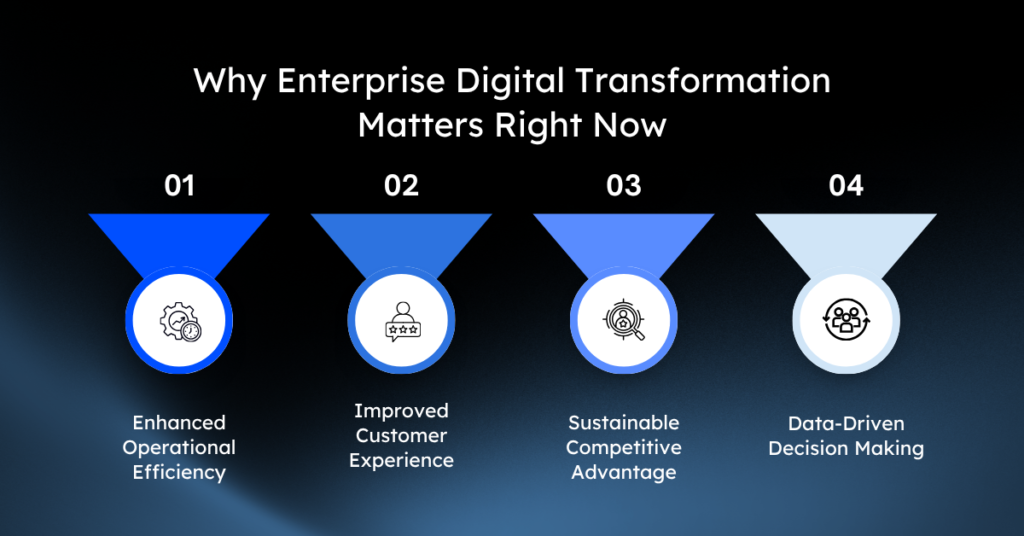
The enterprises that succeed share one common trait: they treat transformation as a business strategy, not a technology deployment. Here are the key reasons why enterprise digital transformation matters the most:
Enhanced Operational Efficiency
Manual processes are expensive, not just in direct labor costs, but in the hidden costs of human error, delayed decisions, and missed opportunities. Automating repetitive workflows using Robotic Process Automation (RPA) and intelligent workflow tools strip out operational friction at scale.
Freed from routine data prep and administrative tasks, your team shifts its capacity toward analysis, innovation, and customer engagement.
Improved Customer Experience
Customer behavior has fundamentally changed. People now expect seamless, personalized, and immediate digital interactions across every touchpoint. Enterprises that cannot meet that expectation see it directly reflected in their churn metrics and Net Promoter Scores.
Upgrading your digital customer touchpoints, from your onboarding flow to your support infrastructure, directly impacts retention and lifetime value.
Sustainable Competitive Advantage
Your competitors are not standing still. Companies that execute well on an enterprise IT modernization strategy gain structural advantages that are difficult to replicate: better data, faster product cycles, and lower operational costs. These advantages compound over time.
Data-Driven Decision Making
Perhaps the most undervalued benefit of digital transformation is the shift from intuition-based to evidence-based leadership. When your data is clean, integrated, and accessible in real time, every decision your executive team makes is grounded in what is actually happening in the business, not what someone thinks is happening.
The Key Pillars of Enterprise Digital Transformation
A transformation program built on technology alone will fragment. Lasting change requires alignment across four interconnected pillars.
Technology Infrastructure
The technology layer is the foundation. Core components include:
- Cloud Computing and Cloud-Native Architecture — Enables scalability, flexibility, and cost-efficient infrastructure management. Hybrid and multi-cloud environments allow enterprises to reduce operational overhead while maintaining resilience.
- Artificial Intelligence and Machine Learning — AI and ML move enterprise decision-making from reactive to predictive. Research highlights that AI delivers the most value when enterprises redesign workflows around it, not when it is layered on top of existing processes.
- Data Engineering and Analytics Platforms — Modern data infrastructure enables real-time processing, better governance, and the ability to surface actionable insights from complex datasets.
- Automation and RPA — Robotic Process Automation eliminates repetitive manual tasks, reduces error rates, and accelerates process throughput.
- Cybersecurity and Zero-Trust Architecture — With cybersecurity threats growing in sophistication, a Zero-Trust model that requires strict verification for every user and device is a fundamental operational requirement.
Process Optimization
Technology only delivers value when it is paired with well-designed processes. Process optimization means auditing existing workflows, identifying bottlenecks, removing redundant steps, and redesigning operations around digital capabilities.
Organizational Culture and Leadership
This is where most transformations stall. Technology can be purchased overnight. Culture takes years to build. Leaders who align transformation goals with human behavior by communicating clearly, involving teams early, and celebrating incremental wins can dramatically increase adoption rates.
Data Strategy and Analytics
Data is the raw material of digital transformation. Without a coherent data strategy, even the most sophisticated AI tools will produce noise instead of insight. A strong data strategy covers data collection, storage, governance, quality, and accessibility across the organization.
How to Implement Enterprise Digital Transformation
Speed without structure creates debt. The most successful enterprise transformations follow a phased, deliberate implementation approach.
Phase 1: Assess Your Current Maturity
Before you build a roadmap, you need an honest picture of where you are. Audit three areas:
- Technology landscape — What systems are you running? What is their age, maintenance cost, and integration capability?
- Data infrastructure — Where are your data silos? How clean and accessible is your data?
- Workforce capabilities — What skills does your team have? Where are the gaps?
This assessment prevents costly misalignment between your transformation ambitions and your actual starting point.
Phase 2: Define Clear Business Outcomes
This step separates organizations that succeed from those that fail. Digital transformation must be anchored to specific, measurable business outcomes.
Define:
- The business problems this transformation must solve
- Where value creation is most critical (customer experience, operational efficiency, revenue growth)
- Exact success metrics, for example, a 20% reduction in manual processing time or a 15% improvement in customer retention
Vague goals produce vague results.
Phase 3: Identify Technology Requirements
Once your business outcomes are defined, you can select the specific tools and infrastructure needed to reach them. This includes cloud infrastructure, AI models, APIs integration, and analytics platforms.
This sequence matters. Choosing technology before defining outcomes is the single most common and most expensive mistake enterprises make.
Phase 4: Execute Through Pilot Programs
Avoid organization-wide launches. Instead, roll out changes in small, contained pilot programs that allow you to test assumptions, measure results, and refine before scaling.
Pilot programs reduce execution risk, create internal champions, and build organizational confidence before you commit to full-scale deployment.
Phase 5: Measure, Iterate, and Scale
Digital transformation does not have a finish line. Continuously track performance against your defined KPIs, re-prioritize initiatives based on results, and adjust your approach as market conditions evolve.
Legacy System Modernization: The Hardest Part of the Journey
For most established enterprises, the single biggest obstacle to transformation is the systems they already depend on. Legacy system modernization is not glamorous, but it is unavoidable.
Outdated infrastructure creates three compounding problems:
- Integration friction — Legacy systems cannot connect with modern APIs, creating data silos that prevent organization-wide visibility
- Security exposure — Unsupported hardware and software introduce regulatory risk and vulnerability to cyber threats
- Scalability ceilings — Systems built for a previous era of the business cannot support the demands of a growing, digitally-driven operation
The solution is a phased modernization approach: prioritize the systems with the highest operational impact, leverage cloud migration and microservices to incrementally replace or enhance legacy infrastructure, and allocate a dedicated budget for addressing technical debt without disrupting ongoing operations.
Common Challenges in Enterprise Digital Transformation
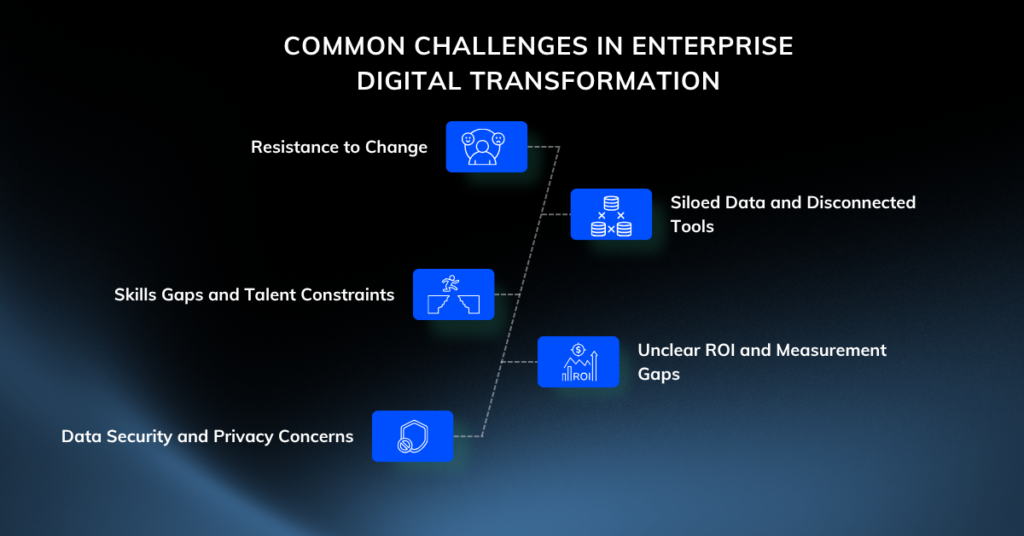
Resistance to Change
People default to familiar processes. Resistance is not irrational—it is a predictable human response to uncertainty. Addressing it requires proactive change management: transparent communication, early stakeholder involvement, and hands-on training that reduces anxiety and builds capability.
Siloed Data and Disconnected Tools
Without data integration, digital initiatives produce fragmented insights instead of clear direction. Implement a unified data strategy that centralizes data sources and ensures all tools integrate seamlessly for cross-departmental collaboration.
Skills Gaps and Talent Constraints
Many organizations lack the internal expertise to execute complex transformation programs. The solution is a combination of targeted workforce upskilling and strategic external partnerships. Working with a specialized IT consulting firm can provide the technical depth and delivery experience needed to bridge gaps during critical transformation phases.
Unclear ROI and Measurement Gaps
Transformation initiatives lose momentum when results cannot be demonstrated. Establish clear KPIs from the outset, align them with board-level priorities, and use analytics tools to track progress and ROI in real time.
Data Security and Privacy Concerns
Expanding your digital footprint increases your attack surface. Embed security measures, including endpoint detection, encryption, and identity management into every stage of your transformation program once systems are live.
The Role of AI in Enterprise Digital Transformation
Artificial intelligence is not a separate initiative. It is the accelerant that makes every other element of transformation more powerful.
Automating Processes at Scale
AI-powered automation handles complex, judgment-based processes that traditional RPA cannot address. It learns from historical data, adapts to edge cases, and scales without proportional increases in headcount.
Enhancing Predictive Analytics
Machine learning models analyze patterns in operational and market data to predict outcomes—customer churn, supply chain disruptions, demand fluctuations—before they materialize. This gives leadership time to act rather than react.
Personalizing Customer Interactions
AI enables enterprises to deliver personalized experiences at scale. From product recommendations to dynamic pricing to individualized support, AI-driven personalization improves customer satisfaction and increases lifetime value.
AI-Driven Strategic Planning
Beyond operational applications, AI is increasingly informing strategic decisions. Scenario modeling, market analysis, and competitive intelligence tools powered by AI give leadership teams a sharper view of risk and opportunity than traditional analysis allows.
What Successful Digital Transformation Looks Like in Practice
The most compelling evidence for enterprise digital transformation comes from organizations that have executed it well.
Domino’s Pizza is one of the most cited examples. From 2010 to March 2017, according to Harvard Business School research, Domino’s share price outperformed that of vaunted tech giants like Apple and Amazon. This performance was driven not by pizza recipes, but by a sustained investment in digital ordering platforms, real-time delivery tracking, and data-driven operations.
The lessons that transfer across industries:
- Commit to a long-term digital vision, not a single project
- Tie every technology investment to a customer or operational outcome
- Build internal capability rather than relying entirely on external vendors
- Measure relentlessly and use data to adjust your approach in real time
Measuring Digital Transformation Success
Operational Efficiency Metrics
- Reduction in manual task hours
- Process automation rates
- System uptime and error rates
- Transaction processing speed
Customer Experience Metrics
- Net Promoter Score (NPS)
- Customer Satisfaction Score (CSAT)
- Digital channel adoption rates
- Customer complaint resolution time
Revenue and Growth Indicators
- Revenue attributable to digital products or channels
- Customer Acquisition Cost (CAC) and Lifetime Value (LTV) trends
- Time-to-market for new products or features
- Market share growth
Technology and Data Maturity
- System integration rates
- Percentage of decisions made using data-driven insights
- Data accessibility improvements across departments
Future Trends Shaping Enterprise Digital Transformation
Hyperautomation
Hyperautomation extends RPA with AI, machine learning, and process mining to automate not just individual tasks, but end-to-end business processes.
Gartner identifies hyperautomation as one of the most significant enterprise technology trends that enable organizations to rapidly identify and automate as many processes as technically possible.
Sustainable Digital Transformation
Environmental, social, and governance (ESG) considerations are increasingly integrated into transformation strategies.
Enterprises are using digital tools to track carbon footprints, optimize energy consumption across data centers, and report sustainability metrics to investors and regulators with greater accuracy.
Agentic AI and Autonomous Decision-Making
The next generation of AI moves beyond providing recommendations to take autonomous actions. Agentic AI systems can execute multi-step workflows, respond to real-time events, and coordinate across systems without human intervention, which compresses decision cycles dramatically.
Start Your Enterprise Digital Transformation the Right Way with Enlight Lab
Enterprise digital transformation is a strategic necessity for organizations that want to remain competitive, agile, and customer-focused. Companies that successfully embrace modern technologies can unlock new opportunities, streamline operations, and create innovative experiences that drive long-term growth.
The 70% failure rate is real, but it is not inevitable. Organizations that define clear business outcomes, execute in structured phases, invest in their people alongside their technology, and partner with experienced delivery teams consistently outperform those that do not.
The cost of waiting compounds every quarter is high. Outdated systems accumulate debt. Competitors close the gap. Customers migrate to better experiences.
If your enterprise is ready to modernize its systems, Enlight Lab is right at your fingertips to provide customized technology solutions designed to create measurable impact. With a strong focus on innovation, efficiency, and business outcomes, we support organizations through every stage of modernization.
Our key areas of expertise include:
- Cloud Solutions: Enable greater flexibility, scalability, and operational efficiency by harnessing the power of secure and future-ready cloud platforms.
- Data & Analytics: Convert complex data into meaningful insights that support smarter decisions, improve performance, and uncover new business opportunities.
- Legacy Application Modernization: Transform traditional systems into modern, efficient, and technology-driven platforms.
- Generative AI Solutions: Leverage the capabilities of advanced AI to automate processes, enhance customer engagement, and drive innovation.
By combining our deep technical expertise with emerging technologies, we help you build resilient, intelligent, and future-ready businesses transformation roadmap that delivers real business outcomes. Partner with Enlight Lab to turn digital transformation challenges into opportunities and create a smarter path toward sustainable business success.