If you’re weighing a custom CRM against Salesforce or HubSpot, the first question is always the same: what will it actually cost? The honest answer is that there’s no single price tag. A custom CRM is a piece of software built around your exact workflows, so the cost tracks closely with how much you ask it to do.
This guide breaks down custom CRM development cost in 2026 into clear ranges, explains the variables that move the number up or down, and gives you a decision framework for when building makes financial sense. You’ll also find a feature-by-feature cost table, a comparison against off-the-shelf platforms, and the hidden costs most vendors leave out of their first quote.
By the end, you’ll be able to estimate a realistic budget for your own project and know which questions to ask before signing a development contract.
Key Custom CRM Pricing Insights
- Basic CRM: $30,000–$60,000. Core contact and lead management, minimal integrations.
- Small business CRM: $60,000–$120,000. Sales pipelines, automation, reporting.
- Mid-market CRM: $120,000–$250,000. Deeper integrations, role-based access, dashboards.
- Enterprise CRM: $250,000–$500,000+. High scalability, compliance, custom architecture.
- AI-powered CRM: Add $40,000–$150,000+ on top, depending on the AI features involved.
- Biggest cost drivers: feature count, third-party integrations, AI, security/compliance, and scale.
- Timeline: 3 to 12+ months depending on complexity.
- Ongoing cost: budget 15–25% of the build cost per year for maintenance and hosting.
What Is Custom CRM Development?
Custom CRM development means building a customer relationship management system from the ground up, tailored to how your business actually operates. It’s different from buying a subscription to an existing platform.
Four terms often get mixed up. Here’s how they differ:
- Custom-built CRM: Software developed specifically for your business. You own the code and control every feature.
- Off-the-shelf CRM: A ready-made product like Salesforce or HubSpot that you rent through a subscription. You adapt your process to the tool.
- CRM customization: Modifying an off-the-shelf CRM with add-ons, custom fields, or plugins. You’re still tied to the base platform’s limits.
- CRM implementation: The process of setting up, configuring, and rolling out a CRM (custom or off-the-shelf) across your team.
The choice matters because it shapes your entire cost structure. A custom-built CRM has a higher upfront cost but no per-seat subscription. An off-the-shelf CRM costs less to start but charges monthly, often per user, for years.
How Much Does Custom CRM Development Cost in 2026?
Below are realistic ranges for custom CRM software development in 2026. Treat these as estimates. Actual quotes shift with your region, the development team’s rates, and the specifics of your requirements.
| CRM Tier | Typical Cost (2026) | What’s Included |
|---|---|---|
| Basic | $30,000–$60,000 | Contact management, lead capture, basic reporting, single-team use |
| Small Business | $60,000–$120,000 | Sales pipelines, workflow automation, email integration, standard dashboards |
| Mid-Market | $120,000–$250,000 | Role-based access, multiple integrations, custom reporting, mobile access |
| Enterprise | $250,000–$500,000+ | Advanced security, compliance (GDPR/HIPAA/SOC 2), high scalability, custom architecture |
| AI-Powered | +$40,000–$150,000+ | Lead scoring, sales forecasting, AI assistants, natural language search |
The AI tier is additive. A mid-market CRM with AI-powered lead scoring and forecasting might land at $180,000 for the core build plus $80,000 for the AI layer.
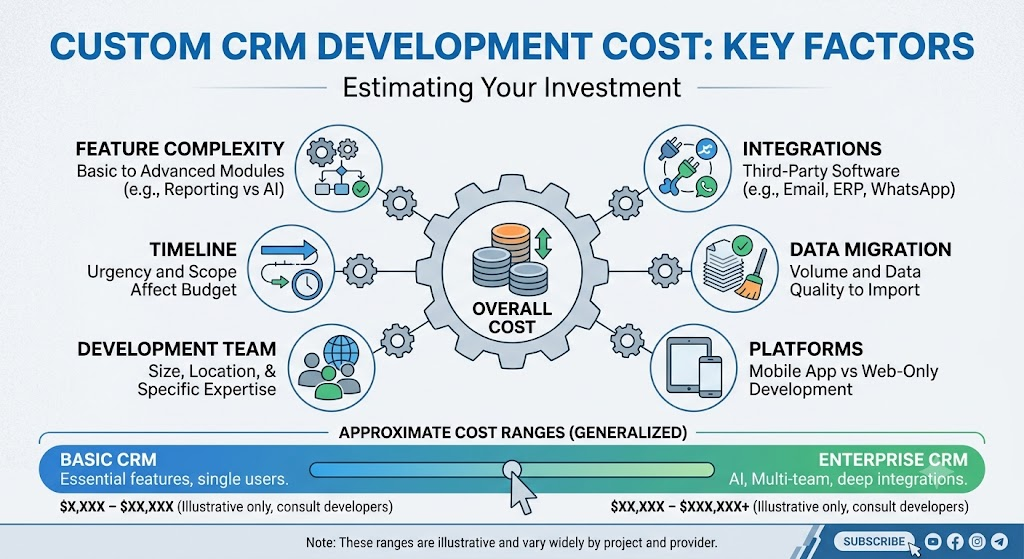
What Factors Affect Custom CRM Development Cost?
Five variables account for most of the difference between a $50,000 project and a $400,000 one.
How do features affect CRM development cost?
Every feature adds design, development, and testing hours. A CRM with basic contact management costs far less than one with automated sales pipelines, custom workflow rules, and configurable dashboards.
Core features that drive cost:
- Lead and contact management
- Sales pipeline tracking
- Workflow automation
- Reporting and analytics dashboards
- Role-based access control
The more logic a feature contains, the more it costs. A static report is cheap. A dashboard that lets each user build custom views is expensive.
How much do third-party integrations add to CRM cost?
Integrations are one of the most underestimated costs. Each connection to an outside system needs its own development and maintenance work.
Common integrations include:
- Email platforms (Gmail, Outlook)
- ERP and accounting software
- Marketing automation tools
- Payment systems
- Data warehouses and custom APIs
A single simple integration might add $3,000–$8,000. Complex, two-way syncs with an ERP can add $20,000 or more. Plan these early, because retrofitting integrations later is expensive.
How much do AI features increase CRM cost?
AI is the fastest-growing line item in custom CRM pricing. The cost depends on which capabilities you want and whether you build models or use existing AI APIs.
AI features and their relative cost:
- Lower cost: conversation summaries, automated follow-ups (built on existing AI APIs)
- Medium cost: lead scoring, natural language search
- Higher cost: custom sales forecasting models, embedded AI assistants
Beyond development, AI adds a recurring expense: API usage fees. Every summary, score, or query that calls an external AI model carries a per-use cost that grows with your volume.
Does mobile access change the price?
Yes, and the approach you pick has a big impact.
- Web-only: Lowest cost. Works in a browser on any device.
- Cross-platform app: Medium cost. One codebase for iOS and Android.
- Separate native apps: Highest cost. Two codebases, two sets of testing.
For most businesses, a responsive web app or a cross-platform app covers the need without the expense of separate native builds.
How do security and compliance affect cost?
Security requirements can add a significant amount, especially in regulated industries. Basic role-based access and encryption are expected in any modern CRM. Compliance frameworks are where costs climb.
- Encryption and audit logs: baseline
- Single sign-on (SSO): moderate add-on
- GDPR compliance: moderate
- HIPAA (healthcare): significant, requires strict data handling
- SOC 2: significant, requires ongoing controls and audits
If you handle health or financial data, budget for compliance from day one. Adding it later usually means rework.
How does scale affect CRM development cost?
A CRM built for 10 users is architecturally different from one built for 1,000. Enterprise-scale systems need infrastructure that handles high traffic, concurrent users, and large data volumes without slowing down. That architecture takes more senior engineering time and drives up both the build cost and the hosting bill.
Custom CRM Development Cost by Feature
This table shows how individual features stack up in complexity and cost impact.
| Feature | Complexity | Cost Impact |
|---|---|---|
| Contact management | Low | Low |
| Lead capture forms | Low | Low |
| Sales pipeline | Medium | Medium |
| Workflow automation | Medium–High | Medium–High |
| Custom dashboards | Medium–High | Medium–High |
| Role-based access control | Medium | Medium |
| Email integration | Low–Medium | Low–Medium |
| ERP/accounting integration | High | High |
| AI lead scoring | High | High |
| Sales forecasting (AI) | High | High |
| Mobile app (cross-platform) | Medium–High | Medium–High |
| Compliance (HIPAA/SOC 2) | High | High |
Use this as a checklist. Every item you add moves your total up. Cutting the low-value features is the fastest way to control your budget.
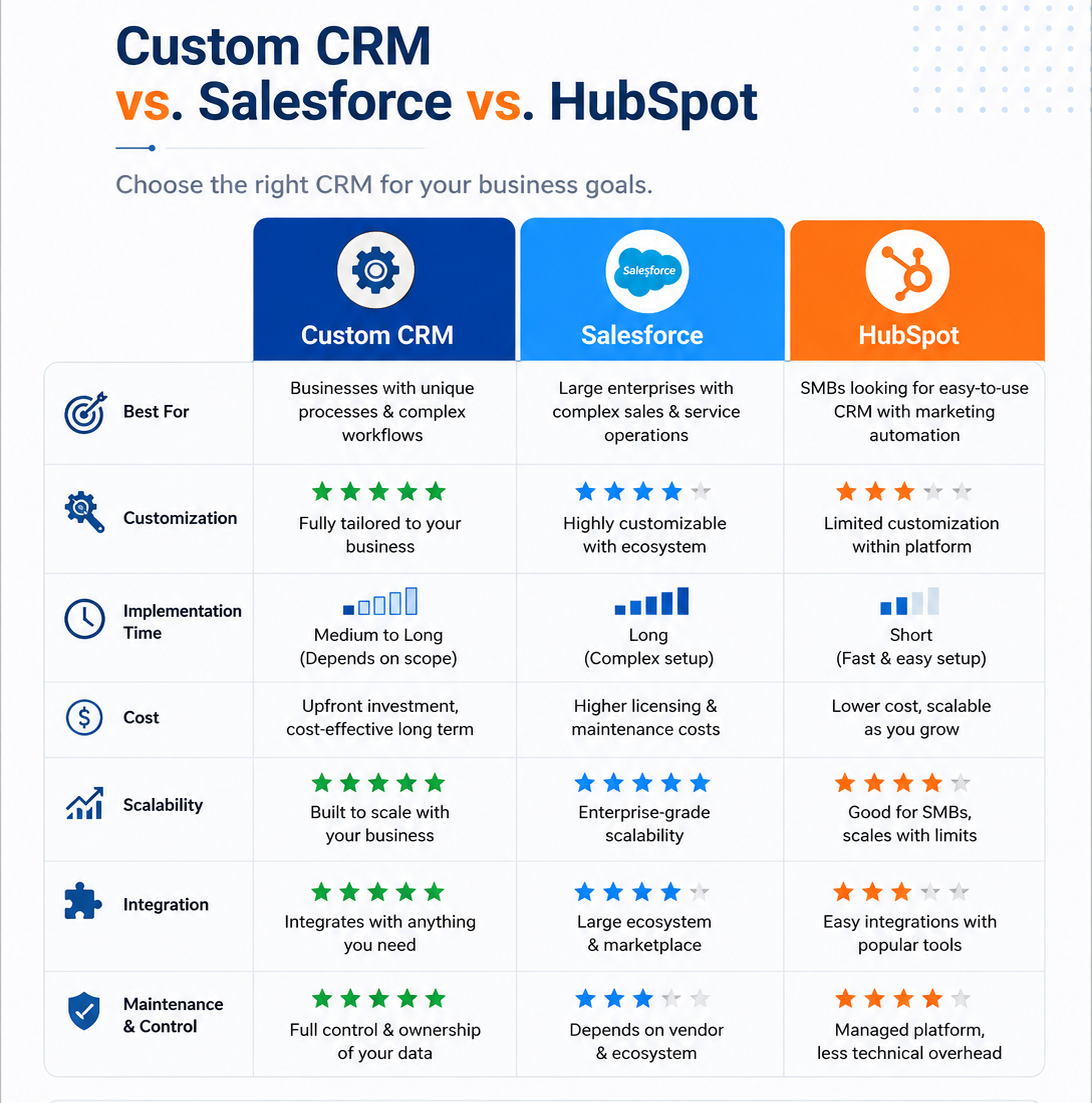
Custom CRM vs. Salesforce vs. HubSpot
The build-versus-buy decision comes down to more than the sticker price. Here’s a balanced comparison.
| Factor | Custom CRM | Salesforce | HubSpot |
|---|---|---|---|
| Upfront cost | High ($30K–$500K+) | Low | Low to free |
| Subscription | None | Per user, monthly | Per user, monthly (tiered) |
| Customization | Unlimited | High, within platform limits | Moderate |
| Ownership | You own the code | Vendor-owned | Vendor-owned |
| Scalability | Built to your needs | Strong, but pricing scales fast | Good for SMBs, costly at scale |
| Integration flexibility | Full control | Broad marketplace | Solid, but capped on lower tiers |
| Long-term cost | Front-loaded, predictable | Grows with users and add-ons | Grows with users and features |
Choose an off-the-shelf CRM if your workflows are standard, you need to launch fast, and your team size is stable. Salesforce suits complex sales orgs willing to pay for its ecosystem. HubSpot fits small and mid-sized teams that want an easy start.
Choose a custom CRM if your workflows don’t fit standard tools, per-seat subscription costs are becoming painful as you grow, you need data ownership for compliance, or you require deep integrations that off-the-shelf platforms can’t handle cleanly.
The math often favors custom over the long term. A 200-person sales team paying $150 per user per month spends $360,000 a year on subscriptions. Over three years, that’s more than a mid-market custom build, and you’d own the result.
Hidden Costs of Building a Custom CRM
The build quote is rarely the full picture. These costs are real and often missing from a first estimate.
- Requirements gathering: Discovery workshops and documentation before a line of code is written.
- UX/UI design: Wireframes, prototypes, and user testing.
- Data migration: Moving records from your old system, cleaning them, and validating them. This is often more complex than expected.
- API and cloud infrastructure: Monthly hosting, storage, and bandwidth.
- AI API usage: Per-call fees that scale with usage.
- Security testing and QA: Penetration testing, code review, and quality assurance.
- Ongoing maintenance: Bug fixes, updates, and support, typically 15–25% of the build cost per year.
- DevOps: Deployment pipelines, monitoring, and scaling infrastructure.
Underestimating these is a common reason projects run over. If you want a deeper look at how budgets slip, our guide on why software projects go over budget covers the warning signs.
How Long Does It Take to Build a Custom CRM?
Timeline scales with complexity, much like cost.
| CRM Type | Typical Timeline |
|---|---|
| Basic CRM | 3–4 months |
| Mid-complexity CRM | 5–8 months |
| Enterprise CRM | 9–12+ months |
AI features, heavy integrations, and compliance work all extend these ranges. A phased rollout, starting with core features and adding the rest later, can get you a working system faster while spreading the cost.
How to Reduce Custom CRM Development Costs
You can build a capable CRM without overspending. These tactics keep the budget in check:
- Start with an MVP. Build the smallest version that solves your core problem, then expand based on real use. Our MVP development approach is designed for exactly this. If you’re new to scoping, read how to scope an MVP in 2026.
- Prioritize core workflows. Identify the two or three processes that drive revenue and build those first.
- Cut features that don’t earn their cost. Every “nice to have” adds development and maintenance time.
- Plan integrations early. Retrofitting connections is far more expensive than designing for them upfront.
- Use existing AI APIs instead of building custom models where possible.
- Choose the right architecture from the start. Rebuilding for scale later costs more than planning for it now. Our startup tech stack selection guide can help you make sound early decisions.
- Pick a web or cross-platform app over separate native apps unless you have a clear reason not to.
When Should a Business Build a Custom CRM?
Not every business needs a custom CRM. Use this framework to decide.
Build a custom CRM when:
- Your workflows are unusual and don’t map to off-the-shelf tools.
- Subscription costs are climbing as your team grows.
- You need full data ownership for compliance or security.
- You require integrations that standard platforms can’t support.
- The CRM is central to a competitive advantage you want to control.
Stick with off-the-shelf when:
- Your sales and support processes are standard.
- You need to launch in weeks, not months.
- Your team is small and unlikely to scale rapidly.
- Your budget can’t support a five- or six-figure upfront investment.
The clearest signal to build is when you find yourself paying for an expensive off-the-shelf CRM and still forcing your process to fit the tool.
How Enlight Lab Can Help
Enlight Lab builds custom CRM systems around the way your business actually works. We start with a clear scope, a realistic budget, and a plan that avoids the hidden costs that derail projects.
Our team handles everything from requirements gathering and UX design through development, integrations, AI features, and long-term maintenance. Whether you need a lean MVP or an enterprise-scale platform, we help you make the build-versus-buy decision with real numbers.
Explore our custom software development services to see how we approach projects like yours, or reach out for a scoped estimate based on your requirements.