The top IT staff augmentation trends 2026 introduces include a shift toward AI-powered talent matching, hyper-specialization in niche technologies like MLOps, and outcome-based pricing models. Many companies are increasingly relying on global, remote-first talent pools to accelerate feature deployment, integrate ethical AI, and ensure rigorous cybersecurity compliance within distributed engineering teams.
The traditional model of IT staff augmentation is officially dead. Hiring a vendor just to throw “warm bodies” at a sprawling backlog no longer works. It creates internal bottlenecks, misaligns with business goals, and drains ROI. Instead, scaling engineering velocity in 2026 requires strategic, high-velocity integration.
You need flexible technical talent that operates with end-to-end ownership, but unfortunately, hiring locally takes months. You face pressure to deploy AI features yesterday, yet your core engineering team is already stretched too thin.
This is exactly where modern staff augmentation steps in to accelerate your growth.
As we look ahead, the IT staff augmentation trends are actively reshaping how high-growth companies build software products. Companies are moving away from treating external developers as temporary gap-fillers. Instead, forward-thinking organizations are leveraging IT staff augmentation services from specialized consulting firms like Enlight Lab to gain flexible access to expert talent and maintain seamless execution across complex projects.
Let us explore the nine transformative trends redefining how software teams scale, deploy, and succeed.
What Defines IT Staff Augmentation Trends in 2026?
IT staff augmentation trends 2026 focus on how companies scale faster by using flexible talent models, AI-driven hiring, and global remote teams. Instead of relying only on full-time hiring, you can access specialised skills on demand, reduce hiring delays, and keep delivery moving without long-term commitments.
Why It’s Crucial for Scaling Delivery in 2026
The global IT staff augmentation market is expanding rapidly and is projected to reach $857.2 billion by 2032. At the same time, 75% of employers globally report difficulty finding the skilled talent they need, making flexible hiring models more critical than ever. Staff augmentation directly solves this talent gap by providing rapid access to specialized skills, making it an essential strategy for scaling delivery pipelines in 2026 and beyond.
Difference Between Staff Augmentation, Managed Services, and Outsourcing
It’s helpful to understand the distinctions between these IT models:
- IT Staff Augmentation: Choose this when you want to retain direct control over developers and integrate them into your existing team and workflows.
- Managed Services: Opt for this when you need a vendor to take over an entire operational function, like 24/7 server monitoring.
- Project Outsourcing: Use this when you want to hand off an entire software build from start to finish, relinquishing day-to-day management.
9 IT Staff Augmentation Trends Transforming Delivery in 2026
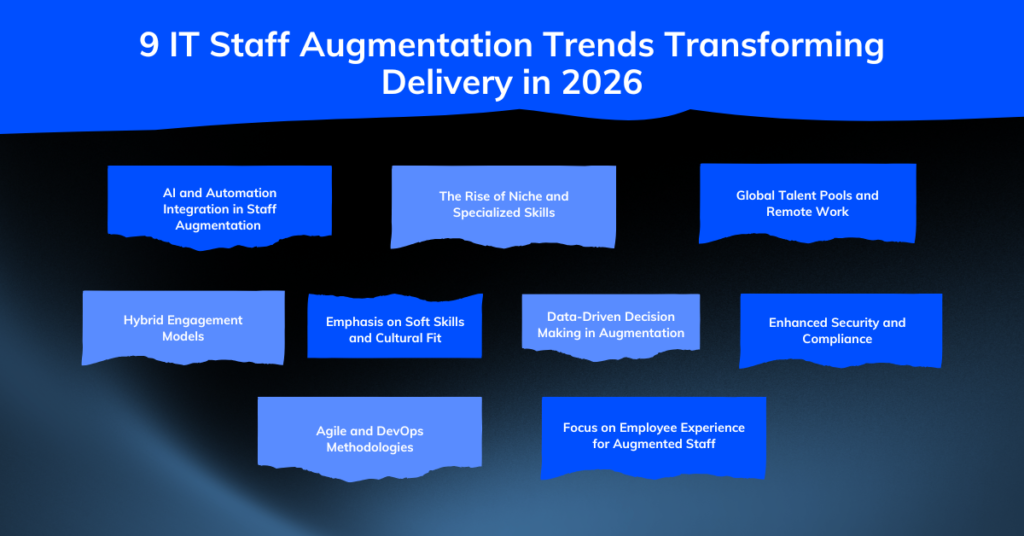
Below are the 9 key trends shaping how you scale delivery today. Each one directly impacts how quickly and effectively you can execute your roadmap.
Trend 1: AI and Automation Integration in Staff Augmentation
AI-powered talent matching platforms are drastically reducing the time it takes to find the perfect engineer. Instead of manually reviewing resumes, vendors use machine learning to analyze historical project data, code repositories, and communication styles to predict candidate success.
Automation’s role in project management and workflow
Once augmented engineers join your team, AI handles the heavy lifting of project management. Automated workflows assign Jira tickets based on developer velocity, flag potential bottlenecks, and streamline the code review process.
Impact on efficiency and cost
Pairing augmented staff with AI copilots can significantly boost efficiency and reduce costs.
- Increased Development Speed: Achieve up to 1.5x faster development cycles.
- Faster Coding: Generative AI tools empower developers to write and refactor code more quickly.
- Improved Output: Your augmented team can deliver more feature points per sprint.
- Reduced Costs: Drive down the overall cost-per-feature by increasing productivity.
Trend 2: The Rise of Niche and Specialized Skills
Demand for expertise in AI/ML, cybersecurity, blockchain, cloud computing
We are seeing an unprecedented surge in demand for highly specific technical skills. Generalist backend engineers are being replaced by requests for specialists in MLOps, quantum computing infrastructure, DevSecOps, and regulatory technology (RegTech).
How staff augmentation helps access these skills quickly
Training internal staff on rapidly emerging technologies takes months. IT staff augmentation allows you to drop a certified AI security analyst or a blockchain architect directly into your active sprint.
Examples of successful niche skill integration
Consider a mid-sized fintech startup needing to implement a new machine learning fraud detection model. Instead of spending 90 days recruiting an internal ML engineer, the CTO uses staff augmentation to bring in a specialized data science pod. The pod builds the model, trains the internal team on maintenance, and rolls off the project in exactly four months.
Trend 3: Global Talent Pools and Remote Work
The shift from local to global talent sourcing
In Q3 2024, Robert Half reported that 35% of new U.S. job postings offered either hybrid or fully remote work arrangements, signaling a major shift away from location-based hiring. CTOs are building distributed teams across Eastern Europe, Latin America, and Southeast Asia to capture top-tier talent at competitive rates.
Advantages of remote staff augmentation
Building a remote augmented team provides three massive strategic advantages. First, you reduce operational costs. Second, you inject diverse problem-solving perspectives into your product architecture. Third, by hiring across different time zones, you establish a 24/7 continuous development cycle.
Challenges and how to overcome them
To make global talent work, IT leaders must standardize communication. Here’s how:
- Overlap core working hours by at least three hours daily.
- Use this time for standups and architecture reviews.
Trend 4: Hybrid Engagement Models
Combining in-house teams with augmented staff
The most resilient engineering departments use a hybrid core-and-flex model. You maintain a core team of internal engineers who hold the institutional knowledge and product vision. You then wrap an elastic layer of augmented staff around them to handle feature sprints and specialized tasks.
The benefits of flexibility
This hybrid model protects your runway:
- Scale up: When you close a new funding round and need to ship new features quickly, you can easily scale up the augmented layer.
- Scale down: When the product stabilizes, you can scale the augmented layer back down without conducting painful internal layoffs.
When to choose a hybrid model
A hybrid IT staffing model is ideal when:
- Your product demands fluctuate predictably.
- You are entering a new market and require temporary localization expertise.
Trend 5: Emphasis on Soft Skills and Cultural Fit
Technical skills are not enough.
An augmented engineer with a perfect GitHub commit history will still fail if they cannot communicate blockers during a daily standup. As staff augmentation deeply integrates external workers into internal processes, emotional intelligence and proactive communication are non-negotiable.
Importance of communication, collaboration, and adaptability
- Master asynchronous communication tools: Augmented staff should be proficient with platforms like Slack and Loom.
- Provide confident feedback: They must have the confidence to challenge problematic technical requirements.
- Collaborate openly: Active participation in sprint retrospectives and other team discussions is crucial.
How to assess cultural fit in remote or augmented teams
To assess cultural fit remotely:
- Conduct paired programming interviews: This is the best way to assess cultural fit before hiring.
- Test reactions to feedback: See how the candidate handles constructive criticism and suggestions.
- Evaluate technical explanations: Assess their ability to clearly articulate their decisions.
- Match working styles: Determine if their approach aligns with your internal engineering culture.
Trend 6: Data-Driven Decision Making in Augmentation
Using analytics to optimize staff augmentation strategies
Tech leaders in 2026 do not guess when they need to hire. They use predictive analytics. By analyzing backlog complexity and current sprint velocity, engineering managers can forecast specific skill shortages three to six months in advance.
Metrics for measuring success
To ensure your IT staff augmentation vendor is delivering value, track specific metrics. Monitor the escaped defect rate, lead time for changes, and story points completed. Avoid tracking vanity metrics like hours logged.
Predictive analytics for future staffing needs
Advanced workforce analytics tools now automatically recommend the optimal team composition for upcoming product roadmaps, ensuring you lock in specialized talent before market demand peaks.
Trend 7: Enhanced Security and Compliance
Addressing data security concerns with remote and augmented teams.
With 59% of organizations reporting significant or critical cybersecurity skills deficiencies in 2026, securing AI-augmented workflows has become a top operational priority. Augmented staff must operate within zero-trust network architectures, using virtual desktop infrastructure (VDI) to prevent source code from residing on local machines.
Ensuring compliance with industry regulations (GDPR, HIPAA)
If your startup operates in healthcare or finance, your augmented IT staff must be compliance-aware. Require vendors to provide talent certified in GDPR, HIPAA, SOC 2, or ISO 27001 standards.
Best practices for secure staff augmentation
Here are some frameworks you can implement to secure your augmented staff:
- Implement strict role-based access control (RBAC): This ensures that augmented staff only have access to the resources they need.
- Limit access for developers: Augmented developers should only be granted access to the specific repositories and cloud environments required for their immediate tasks.
Trend 8: Agile and DevOps Methodologies
IT staff augmentation thrives in Agile environments. Because augmented professionals are hired for specific skill sets, they can immediately pick up sprint tickets without navigating weeks of corporate red tape.
Integrating augmented staff into DevOps pipelines
Augmented DevSecOps engineers build automated CI/CD pipelines that enforce internal quality standards. This ensures that code written by an external contractor in Colombia passes the exact same automated testing criteria as code written by your lead internal architect in New York.
Benefits for continuous delivery and rapid iteration
By adding augmented QA automation engineers and DevOps specialists to your roster, your internal team spends less time fighting deployment fires and more time building core product value.
Trend 9: Focus on Employee Experience for Augmented Staff
Treating augmented staff as integral team members.
High-performing startups do not treat augmented engineers like second-class citizens. If you want maximum productivity, give your augmented staff the same context, respect, and technical context you give your full-time employees.
Importance of onboarding, training, and integration
Effective onboarding is the highest leverage activity in IT staff augmentation. Provide your augmented engineers with comprehensive documentation, access to system architecture diagrams, and a dedicated internal engineering buddy for the first two weeks.
Impact on retention and productivity
When augmented engineers feel valued and understand the business impact of the code they write, their code quality improves, and their turnover rate drops.
What Actionable Steps Should IT Companies Take to Prepare For 2026?
Assessing current and future needs
Audit your current product roadmap and identify which features are consistently delayed. Pinpoint the exact technical skills required to unblock those features.
Developing a robust strategy
Shift your hiring framework from a role-based model to a skills-based model. Build partnerships with niche IT staff augmentation vendors who specialize in your specific industry vertical rather than relying on massive, generalist staffing agencies.
Investing in the right platforms
Upgrade your internal documentation. Clean up your Jira boards. Ensure your CI/CD pipelines are fully automated. Augmented engineers can only move fast if your internal technical foundation is stable.
Ready to scale your delivery with these IT staff augmentation trends for 2026?
The days of viewing staff augmentation as a simple body-shopping exercise are over. The IT staff augmentation trends shaping 2026 are changing how you scale your engineering team. With AI-driven talent matching and outcome-based project delivery, you can grow faster without overwhelming your internal leadership.
By embracing global talent pools, enforcing rigorous cybersecurity measures, and prioritizing specialized expertise, you can confidently accelerate your growth and deliver complex software solutions on time.
If you are ready to eliminate internal bottlenecks and achieve a higher ROI on your engineering investments, it is time to rethink your technical delivery strategy. Partner with Enlight Lab to gain the senior expertise and end-to-end project ownership your growing business demands.